Rules
Portugal's nationality law in 2026: what Lei Orgânica 1/2026 actually changed, article by article
Search for Portuguese citizenship and the first page of results will tell you five years and ten years at the same time, and almost none of it names the law that changed. Lei Organica 1/2026 did two things on 19 May 2026, in two different articles, and the second one is missing from the English-language market entirely: it repealed the paragraph under which time spent waiting for a residence permit counted towards naturalisation.
Checked against Naturalisation: the column that had to be rewrittenPortugal
Jurisdictions pt
Contents
- Lei Orgânica 1/2026: the instrument that changed Portuguese nationality law
- Portuguese citizenship now takes ten years: article 6(1)(b)
- When the ten years start: article 15(4) repealed, and nobody else has this
- Why mixing the two Portuguese nationality changes gives a wrong answer
- What the Portuguese Constitutional Court struck down, and what it left standing
- What the 2026 Portuguese nationality reform did not change
- How to check Portuguese nationality law yourself in four minutes
- Frequently asked questions about Portuguese citizenship after Lei Orgânica 1/2026
- More on Portuguese residence and citizenship
Search for Portuguese citizenship in English today and the first screen of results will tell you, simultaneously, that the period is five years and that it is ten. Two national consulates appear, and so does the government's own portal. Under them sit the firms. Some have updated their pages and some have not, and there is no way for a reader to tell which is which, because almost none of them name the instrument.
That is the actual state of this market in September 2026: not wrong information exactly, but undated information, which is the same thing to anyone trying to plan.
This page names the instrument, quotes the text, and separates the two changes that happened on the same day and are constantly reported as one. The second of them is missing from the English-language market almost entirely, and it is worth more to a golden visa holder than the headline.
Lei Orgânica 1/2026: the instrument that changed Portuguese nationality law
Lei Orgânica n.º 1/2026, published in the Diário da República of 18 May 2026, in force from 19 May. Article 8 is the entry-into-force provision and it is the short kind: the law enters into force the day after its publication.
Article 2 lists what it rewrites in Lei n.º 37/81, the Nationality Act: articles 1, 3, 5, 6, 8, 9, 10, 12-B, 12-C, 14 to 19, and 25. Article 5 is a separate repealing provision, and it is the one this page is really about.
The text was promulgated by the President on 3 May 2026 after an earlier version of the same reform had been sent to the Constitutional Court and returned. That history matters for one specific reason, set out below, and for no other.
Portuguese citizenship now takes ten years: article 6(1)(b)
This is the part the market has, if not always with a date attached. The qualifying period, in the statute's own words:
> "Residirem legalmente no território português há pelo menos sete anos, no caso de nacionais de países de língua oficial portuguesa e de cidadãos de Estados-Membros da União Europeia, ou 10 anos, no caso de nacionais de outros países"
Seven years for nationals of Portuguese-speaking countries and of EU member states. Ten years for everybody else. It was five years for everybody before.
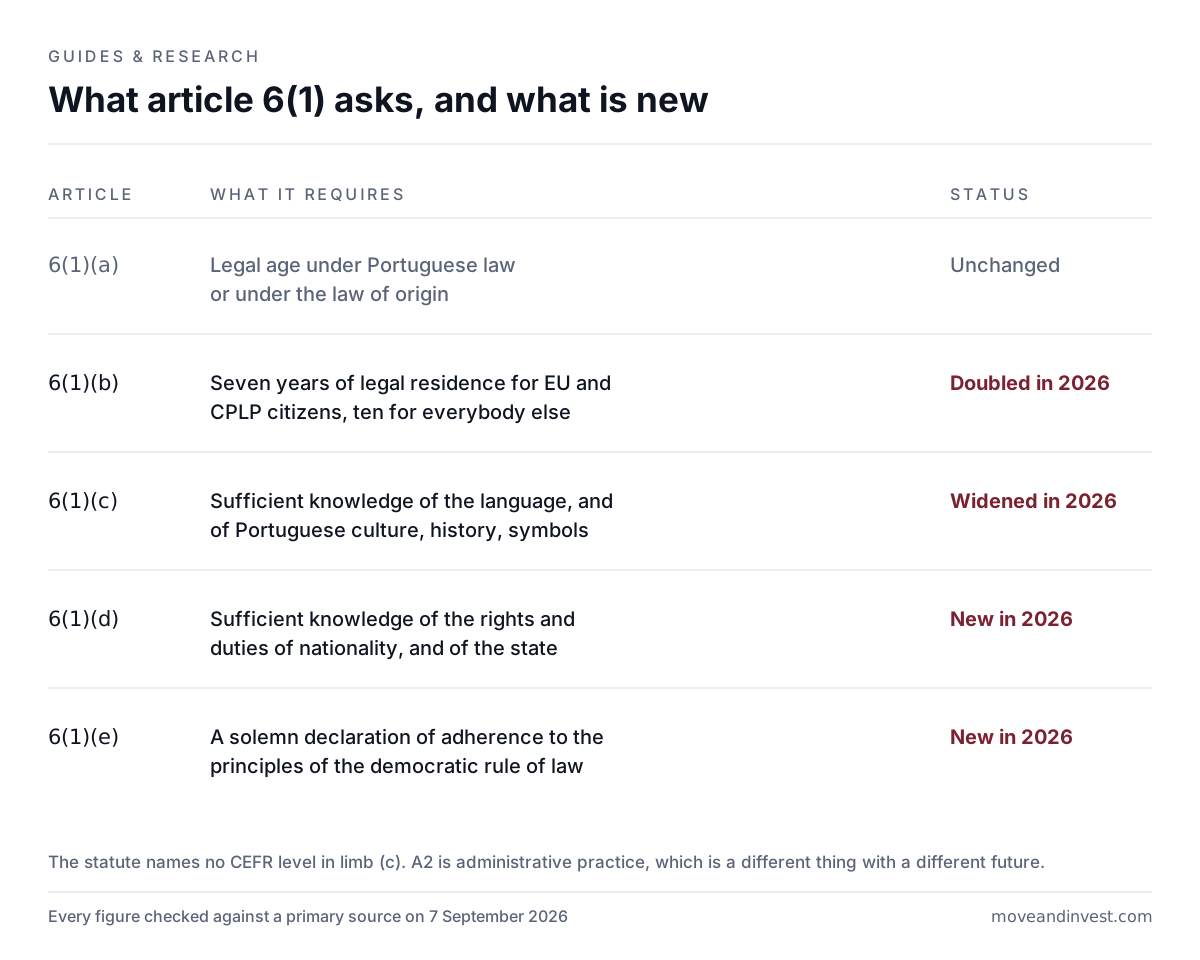
Three further conditions in the same article are newer than the numbers and get far less attention.
Article 6(1)(c) requires the applicant to demonstrate, by test or certificate, sufficient knowledge of "a língua e a cultura portuguesas, a história e os símbolos nacionais" — the language *and the culture, the history and the national symbols*. Until this law, the language stood alone.
Article 6(1)(d) adds sufficient knowledge of the fundamental rights and duties attaching to Portuguese nationality and of the political organisation of the Portuguese state.
Article 6(1)(e) requires a solemn declaration of adherence to the fundamental principles of the democratic rule of law.
No CEFR level appears anywhere in this article. Not A2, not B1, nothing. The market prints A2 constantly, and A2 is what the current administrative practice under the old regime asks for, but a level fixed in practice and a level fixed in statute are different things with different futures — one can be changed by an administrative act. Anyone budgeting for a language certificate should know which of the two they are relying on. The same gap exists in article 80 of Lei 23/2007 for permanent residence, which says "Português básico" and stops.
Article 6(10) keeps a presumption for nationals of Portuguese-speaking countries: they are presumed to satisfy the language limb unless a lack of Portuguese is manifest.
When the ten years start: article 15(4) repealed, and nobody else has this
Here is a question almost no English-language page about Portuguese citizenship answers, and it decides the arithmetic more often than the period does.
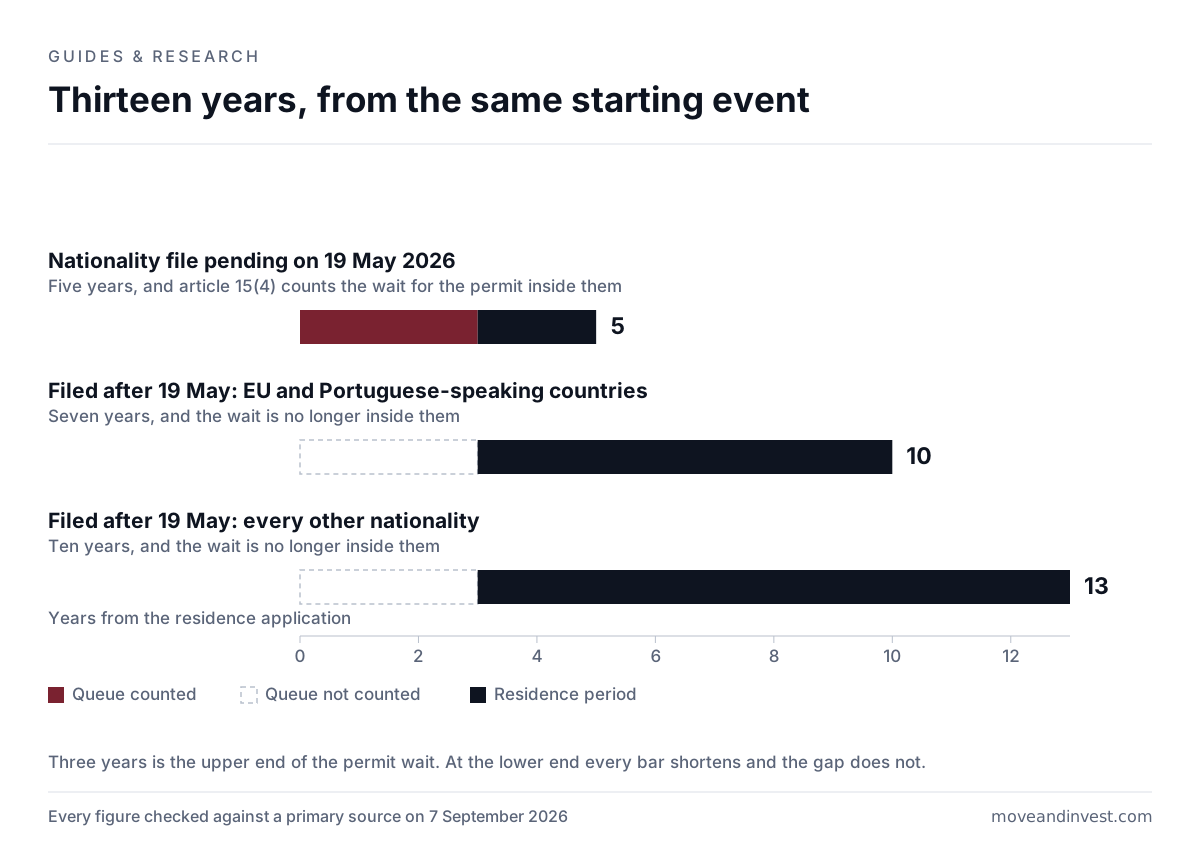
Portugal's immigration authority, AIMA, takes between one and three years to issue a residence permit after the file is submitted. So: does that wait count?
Between 5 March 2024 and 18 May 2026, it did. Lei Orgânica n.º 1/2024 inserted a fourth paragraph into article 15 of the Nationality Act, which said, in full:
> "Para os efeitos de contagem de prazos de residência legal previstos na presente lei, considera-se igualmente o tempo decorrido desde o momento em que foi requerida a autorização de residência temporária, desde que a mesma venha a ser deferida."
Time from the moment temporary residence was *requested* counted, as long as the permit was eventually granted. It was written for exactly the queue described above, and for two years it was worth up to three years of anybody's clock.
Article 5 of Lei Orgânica 1/2026 repeals it. The repealing provision names it among the casualties, in a list:
> "São revogados os n.os 5, 7 e 13 do artigo 6.º, as alíneas b) e d) do n.º 1 e os n.os 3 e 4 do artigo 9.º, o n.º 4 do artigo 12.º-B, o artigo 13.º e o n.º 4 do artigo 15.º da Lei n.º 37/81"
In the republished text of article 15, paragraph 4 now reads, in its entirety, "[Revogado.]"
What is left is paragraph 1, which is the general definition and has not changed:
> "Para os efeitos do disposto nos artigos precedentes, entende-se que residem legalmente no território português os indivíduos que aqui se encontram, com a sua situação regularizada perante as autoridades portuguesas, ao abrigo de qualquer dos títulos, vistos ou autorizações previstos no regime de entrada, permanência, saída e afastamento de estrangeiros e no regime do direito de asilo."
Two things follow from reading that sentence rather than a summary of it.
It is broader than the residence card. Legal residence means regularised status under *any* title, visa or authorisation of the immigration or asylum regime. A national residence visa is a visto. Somebody who enters on a D-visa and only later receives a card is not starting from the card.
And it is narrower than the repealed paragraph. A title, visa or authorisation is a thing that exists. A pending application for one is not. That is precisely the gap article 15(4) was written to bridge, and the bridge has been removed.
There is a third paragraph worth knowing, unchanged and widely misread: article 15(3) allows the periods to be broken. It counts the sum of all periods of legal residence, continuous or interpolated, provided they fall within a maximum window of 6, 9 or 12 years — for stateless persons, for CPLP and EU citizens, and for everybody else respectively. So the ten years for a third-country national need not be consecutive, but they must fit inside twelve.
Why mixing the two Portuguese nationality changes gives a wrong answer
The transitional provision is article 7(2), and it is the sentence that decides which set of rules a particular reader lives under:
> "2 — Aos procedimentos administrativos pendentes à data da entrada em vigor da presente lei aplica-se a Lei n.º 37/81, de 3 de outubro, na redação anterior à presente lei."
Administrative proceedings pending on 19 May 2026 are decided under the previous text. The *previous text* — not just the previous period. It includes article 15(4).
So there are two regimes running side by side, and the boundary is a date in the past:
| Nationality file pending on 19 May 2026 | Nationality file opened after 19 May 2026 | |
|---|---|---|
| Qualifying period | Five years | Seven years CPLP and EU, ten years otherwise |
| Does the residence-permit queue count? | Yes — article 15(4) still applies to it | No — the paragraph is repealed |
| What starts the clock | The date temporary residence was applied for | Lawful presence under a title, visa or authorisation |
| Language test | Language only | Language, plus culture, history and national symbols |
| Extra limbs | None | Rights, duties, political organisation, and a solemn declaration |
Note what "pending" attaches to. It is the *nationality* proceeding that has to be pending, not the residence permit and not the investment. A person who has held a Portuguese residence permit since 2021 but has not yet filed for citizenship is on the right-hand column.
This is where the arithmetic bites for the investment routes. A golden visa applicant who filed in 2023, waited two and a half years for a card, and has not yet applied for nationality now has those two and a half years counted at zero. Under the law as it stood in April 2026, they counted in full. That is not a change in the period from five to ten; it is a change from five to ten *plus* the loss of up to three years already served. The route's own arithmetic is set out in our Portugal golden visa guide.
What the Portuguese Constitutional Court struck down, and what it left standing
An earlier version of this reform went to the Constitutional Court, which is why some pages report that the ten-year period was found unconstitutional. It was not.
Acórdão n.º 1133/2025 of 15 December 2025 ruled against four norms of the *earlier decree*: the automatic bar on applicants with convictions over a certain length, a provision of article 12-B, the rule assessing requirements at the date of petition rather than the date of decision, and — by majority — a provision on loss of nationality. The seven- and ten-year periods were not among them. The President then vetoed and returned the text, and the revised text is the law now in force.
A caution about this paragraph specifically. The Court's own site was unreachable when we checked, and the judgment was read from a mirror. It is the only claim on this page not taken from a primary source, which is why it is described rather than quoted, and why it is flagged here rather than in a footnote. Everything else above is quoted from the Diário da República text.
A separate diploma creating loss of nationality as an accessory criminal penalty was vetoed in May 2026 for unconstitutionality and is not in force. It is frequently reported alongside this law and is not part of it.
What the 2026 Portuguese nationality reform did not change
Descent, marriage and birth in Portugal are not what this law rewrote, and the pages that describe the change as "Portugal ends easy citizenship" flatten a distinction that matters to more people than the investment routes do.
Naturalisation by residence, article 6, is what moved. Attribution by descent — the route most searched under "Portuguese citizenship by descent" — runs on articles 1 and 5, which article 2 of the new law also touches but does not lengthen into a residence period. Citizenship by marriage runs on article 3. Anyone in those categories reading a headline about ten years is reading about somebody else's route.
How to check Portuguese nationality law yourself in four minutes
- Open the Lei Orgânica 1/2026 PDF on the Diário da República site. It is the 18 May 2026 issue of the 1st series.
- Find article 2, the altering provision, and read the republished article 6(1)(b) under it. That is the period.
- Find article 5, the repealing provision. Read to the end of the sentence, past the article 9 and article 12-B items, until you reach "o n.º 4 do artigo 15.º".
- Find article 7(2). That tells you which of the two columns above you are in.
- If a page you are reading gives a period without naming this law, you now know something the page does not.
Every act named here has its own line, with its own link, on our sources page.
Frequently asked questions about Portuguese citizenship after Lei Orgânica 1/2026
Is Portuguese citizenship now five years or ten?
Both, depending on when your nationality application was filed. Files pending on 19 May 2026 are decided under the old text, which is five years. Files opened after that date are seven years for citizens of EU member states and Portuguese-speaking countries and ten for everybody else. The rule is article 7(2) of Lei Orgânica 1/2026.
Does time waiting for my residence permit count towards citizenship?
It counted from March 2024 until 18 May 2026, under article 15(4) of the Nationality Act. Article 5 of Lei Orgânica 1/2026 repealed that paragraph. If your nationality proceeding was already pending on 19 May 2026 the old counting still applies to it; otherwise it does not, and with an AIMA queue of one to three years that is the single largest number in most people's calculation.
Does the new law apply retroactively to people who already have residence?
It applies to nationality proceedings, not to residence permits. Holding a permit issued in 2022 does not put you under the old rules — what matters is whether your citizenship application was pending on 19 May 2026. Residence itself is governed by Lei 23/2007 and is a separate question, covered in our guide to [what happens after the permit](entry:portugal-after-permit).
What language level does the law require?
The statute names no CEFR level. Article 6(1)(c) requires sufficient knowledge of the language and of Portuguese culture, history and national symbols, demonstrated by test or certificate. A2 is what practice has asked for, but it is not in this text, and a level set by practice can be changed without a new law.
Does the golden visa still lead to a passport?
It leads to the same naturalisation route as any other residence permit, on the same terms, and that route is now ten years for most investors rather than five, with the permit queue no longer counted. Nothing in the Nationality Act treats investors differently, favourably or otherwise. What the residence route itself still offers is set out in our [Portugal golden visa guide](entry:portugal-golden-visa).
Was the ten-year period found unconstitutional?
No. Acórdão 1133/2025 struck four norms of an earlier decree, none of them the qualifying periods. The text was then revised and promulgated on 3 May 2026.
More on Portuguese residence and citizenship
The comparison of naturalisation periods across all five jurisdictions is in the passport comparison. The Portuguese residence permit itself — renewals, permanent residence at five years, and what actually has to be spent in the country — is in Portugal residency. The investment route and its own arithmetic are in the golden visa guide. Why there is no Portuguese citizenship by investment, and what the golden visa really leads to now, is in Portugal citizenship by investment.
Sources for every act named on this page, with the verdict each one produced and the date it was last read, are on the sources page.
Does any of this apply to your case?
A guide is research, not advice, and it cannot know your circumstances. Say what you are trying to do and we introduce you to one licensed firm in the jurisdiction concerned — free to you, and only if you tick the box.
Sent.
It is with us. The reply comes from a person and says which firm we think fits and why that one.
That did not go through.
An email address and the consent box are the two things we cannot do without. Everything else is optional.
That is on us.
The enquiry did not reach us — the fault is at our end. Write to office@moveandinvest.com and it will be picked up.