Relocation
Greece golden visa requirements, residency and the 7% tax in 2026
Greece asks €800,000 in Attica and €400,000 elsewhere, and the two €250,000 exceptions carry no minimum floor area at all. It asks a person living on their own income to prove €3,500 a month under a ministerial decision no competitor page cites. And whether either route ever reaches permanent residence turns on something almost nobody writes down: not which permit you hold, but how many days you spend in the country.
Checked against GreeceNaturalisation: the column that had to be rewritten
Jurisdictions gr
Contents
- Greece residency options in 2026: the investor permit and the income permit compared
- Greece golden visa requirements 2026: the €800,000, €400,000 and €250,000 thresholds
- Greece golden visa restrictions: the short-term rental ban, resale and the right to work
- Greece golden visa family members under article 95: spouse, children under 21 and parents
- Greece FIP visa income requirement: €3,500 a month, and the decision that actually sets it
- Greece golden visa vs FIP visa: which route costs less, and what each one forbids
- Does time on a Greece golden visa count towards permanent residence? The rule is presence, not permit type
- Greek permanent residence: Μ.1 after five years and Μ.2 after ten
- Greek citizenship after seven years: the naturalisation period and the examination
- Greek non-dom tax regime: article 5A and the €100,000 flat tax
- Greece 7% tax for foreign pensioners: article 5B requirements and the 31 March deadline
- Greece 50% tax exemption for relocating employees: article 5C, and who cannot use it
- Does a golden visa property count towards the article 5A investment? Yes, at €500,000
- Greece golden visa for Russian and Belarusian citizens: what is actually suspended
- Figures in circulation with no legal source
- Frequently asked questions
- What else here bears on this
- Sources: where each figure comes from
Greece runs three entirely different residence routes and a reader is usually shown one of them. There is the investor permit on property, which asks for €800,000 in Attica and €400,000 in most of the rest of the country. There is a second investor permit, far less visible, which asks for €250,000 of equity in a registered startup instead of a building. And there is a permit for people who simply live on their own income, which asks for no purchase at all — only €3,500 a month.
Neither of those is the interesting number. The interesting question is what either one leads to, and there the whole market gets it wrong in the same way: it argues about which permit counts towards permanent residence, when the statute does not count permits at all. It counts days.
Everything below is quoted from the instrument that sets it, with the article number. Where we could not read something at source, this guide says so rather than filling the gap from somebody else's page.
Greece residency options in 2026: the investor permit and the income permit compared
| Route | Type | What it asks for | Employment in Greece | Term |
|---|---|---|---|---|
| Investor permit, property | Β.5 | €800,000, €400,000 or €250,000 depending on where and what | Prohibited | 5 years, renewable |
| Investor permit, startup | Β.6 | €250,000 into a registered startup, for no more than 33% of it | Prohibited | 1 year, then 2 at a time |
| Holders of sufficient resources | Ι.8 | €3,500 a month, or savings | Prohibited | 3 years, renewable |
| EU long-term resident | Μ.1 | 5 years of actual residence, income, Greek | Permitted | 5 years, renewable |
| National ten-year permit | Μ.2 | 10 years of continuous lawful residence | Permitted | 10 years |
Two things in that table are worth reading twice. All three entry routes forbid working in Greece, which surprises people who assumed a residence permit implies a right to earn. And both permanent statuses are reached by residing, which is the subject of the section this guide is built around.
Greece golden visa requirements 2026: the €800,000, €400,000 and €250,000 thresholds
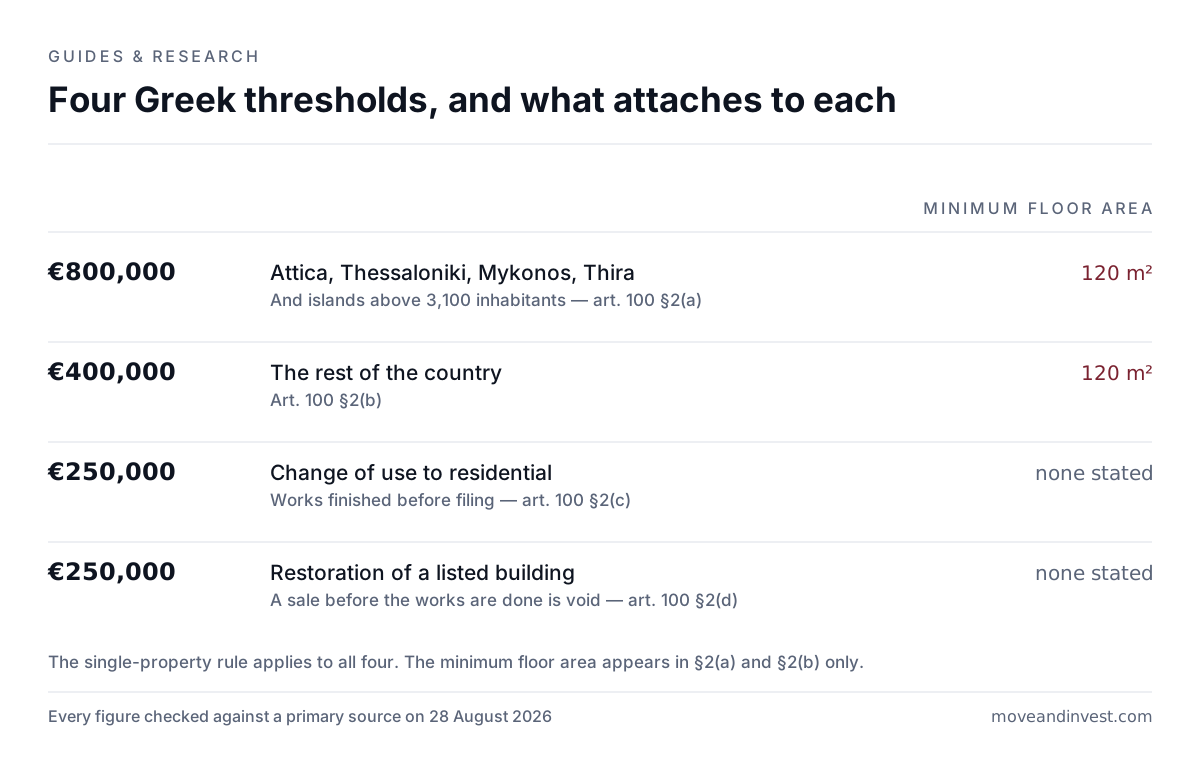
The thresholds are in article 100 of Law 5038/2023, at paragraph 2, in four separate points.
| Threshold | Where and what | Article |
|---|---|---|
| €800,000 | Attica Region, Thessaloniki Regional Unit, Mykonos and Thira Regional Units, and every island with more than 3,100 inhabitants at the last census | §2(a) |
| €400,000 | The rest of the country | §2(b) |
| €250,000 | Principal areas converted to residential use, or an industrial building idle for five years | §2(c) |
| €250,000 | A listed building to be restored or reconstructed | §2(d) |
"From €250,000" is the standard way this market advertises Greece, and it is a description of two exceptions rather than of the programme. Neither €250,000 route lets you buy a finished apartment. One requires a change of use completed before the application is filed; the other requires a restoration you have not yet done.
Greece golden visa €800,000 zone: Attica, Thessaloniki, Mykonos, Santorini and islands over 3,100 inhabitants
The zone wording is a list of named administrative units plus one rule that has to be looked up: «τα νησιά με πληθυσμό, σύμφωνα με την τελευταία απογραφή, πάνω από τρεις χιλιάδες εκατό (3.100) κατοίκους» — islands with more than 3,100 inhabitants at the last census.
We could not obtain that list of islands, and neither, as far as we can tell, has anybody else. No page in this market publishes it. It requires the last census broken down by island, and until somebody produces it the honest position is that the rule is clear and its application to a particular island is a thing to have confirmed before committing money. If a page tells you your island is in the €400,000 band, ask which census table says so.
Greece golden visa €250,000 routes: conversion to residential use and listed building restoration
§2(c), change of use. The threshold applies «εφόσον οι κύριοι χώροι της αλλάζουν σε κατοικία» — where the principal areas change to residential use. The same terms extend to an industrial building, but only one in which no industry has been installed and operating «τα τελευταία πέντε (5) έτη». The change of use must be complete before the application is filed, and the statute expressly allows the seller to be the one who carries it out.
§2(d), listed buildings. A listed building to be restored or reconstructed, at €250,000. Two conditions bite afterwards: a transfer before the restoration is finished is void, not merely penalised, and under §4 the first renewal depends on the restoration having actually been done.
Greece golden visa minimum property size: the 120 m² rule applies to two tiers, not four
The minimum surface appears in §2(a) and §2(b) and nowhere else: «απαιτείται ελάχιστη επιφάνεια κύριων χώρων εκατόν είκοσι (120) τετραγωνικών μέτρων», and only where the property is built or has a building permit.
Neither €250,000 route states any minimum floor area. Pages that print "120 m²" as a rule of the Greek programme are overstating it by half the programme.
What does apply to all four is the single-property rule — «σε ένα μόνο ακίνητο», in identical words in each point. You cannot add two purchases together to reach a threshold. Under §1(b), an undivided share counts only where the co-owners are spouses or partners under a cohabitation agreement; otherwise each share must independently clear the threshold.
The second investor permit: article 100A and the startup route
Beside the four property thresholds sits a second investor permit that most Greek pages omit and most foreign ones misdate. Article 100A of the Migration Code, added by article 44 of Law 5162/2024 and made usable by a joint ministerial decision of November 2025, grants type Β.6 for €250,000 paid into the capital of an enterprise on the Elevate Greece national startup registry — shares in a capital increase, or bonds on a bond issue.
Its conditions are not the property ones. The holding may not exceed 33% of the company or its votes; the enterprise must create two new jobs in the first year and hold that headcount for five years; the shares are locked for five years; the permit runs one year and then two at a time; it confers no right to work, in article 100's own words; and breaching any of it costs €50,000.
That is equity in an early-stage company, not a title deed, and the two are not interchangeable at the same price. The full reading — the paragraph numbers, the documents, and why so much of this market credits the route to the wrong law and the wrong year — is in the piece on the Greek procedure.
Greece golden visa restrictions: the short-term rental ban, resale and the right to work
This is the section most likely to be missing from a page written by somebody selling you the property.
Short-term letting is prohibited and the fine is €50,000. Article 100 §7A treats three things the same way: letting through the sharing economy, sub-letting, and using the property as a company seat. Each one revokes the permit and carries €50,000. A separate €150,000 attaches to failing the restoration condition of §4, and to a transfer in breach of §2(d).
The permit gives no right to work. §9: «δεν καθιερώνουν δικαίωμα πρόσβασης σε οποιαδήποτε μορφή εργασίας» — no right of access to any form of employment.
The money moves before the application, not after. Under §3 the price must be paid in full before filing. Under §5 payment must run through a payment provider operating in Greece, by crossed cheque, transfer or card terminal; a spouse or a relative to the second degree may pay.
The issuing deadline is two months from the complete file reaching the authority, under §10. In practice the queue has been the constraint rather than the deadline: in November 2025 there were 13,499 pending cases, 10,703 of them in Attica, with waits reaching eighteen months.
Greece golden visa family members under article 95: spouse, children under 21 and parents
Article 95 §2 lists them, and it was amended in February 2026 by article 29 of Law 5275/2026 — which added exactly one line, not the broad expansion some pages describe. The amending provision says so itself: «προστίθεται περ. ε)», point (e) is added.
| Who | Condition |
|---|---|
| Spouse, or partner under a cohabitation agreement | Dash |
| Common unmarried children of the couple | Under 21 |
| Unmarried children of either, where custody is lawfully assigned | Under 21 |
| Direct ascendants of the spouses or partners | No age limit and no dependency test stated |
| Adult children lacking legal capacity | Any age, cohabiting and maintained. This is the 2026 addition |
Two consequences worth having in advance. The family member's permit expires at the same moment as the investor's: «λήγει ταυτόχρονα με την άδεια διαμονής του συντηρούντος». And a child who turns 21 does not fall off — the statute grants an autonomous three-year permit, the only requirement being production of the previous family permit.
*One ambiguity we will not smooth over: point (d) grants ascendants "of the spouses or partners". On a strict reading, an unmarried investor with no partner has neither, and so has no route for a parent. We found no guidance or decided case resolving it, and a page that states the generous reading as settled is telling you something it does not know.*
Greece FIP visa income requirement: €3,500 a month, and the decision that actually sets it
The permit for people living on their own income is type Ι.8, and it is not an article of its own — it is paragraph 8 of article 163 of Law 5038/2023. That matters, because a page citing "the FIP article" without a paragraph is not quoting anything you can check.
The statute states no figure. It requires «επαρκείς πόρους, σε επίπεδο σταθερού ετήσιου εισοδήματος» — sufficient resources at the level of a stable annual income — and delegates the amount.
The amount is in KYA 225679/2024, ΦΕΚ Β΄ 5223 of 17 September 2024, article 1 §1(ι): «κατ' ελάχιστο τρεισήμισι χιλιάδες (3.500) ευρώ μηνιαίως», increased «κατά 20% για τη σύζυγο και κατά 15% για κάθε τέκνο».
| Household | Uplift | Per month |
|---|---|---|
| Main applicant | Dash | €3,500 |
| Plus spouse | 20% | €4,200 |
| Plus spouse and one child | 20% + 15% | €4,725 |
| Plus spouse and two children | 20% + 30% | €5,250 |
The €42,000 you will see quoted is 3,500 multiplied by twelve, and for one kind of applicant it is how the test is run. The decision sets a monthly figure and says how it is assessed: «σε μηνιαία βάση» for periodic income such as a pension, and «σε ετήσια βάση σε περίπτωση εισοδημάτων από άλλες πηγές (όπως τραπεζικές καταθέσεις)» — annually where the money comes from other sources, such as bank deposits. This page said until 25 October 2026 that no instrument provides for an annual test; the decision does, for deposits. What it does not state is a single lump sum that covers the whole permit term. The fees and the insurance this permit asks for are in the guide to retiring in Greece.
Can you work on a Greece FIP visa, or work remotely for a foreign employer?
Article 163 §8(γ) is categorical and it covers the whole household: the permit «δεν παρέχει δικαίωμα εξαρτημένης εργασίας ή ανεξάρτητης οικονομικής δραστηριότητας οιασδήποτε μορφής στην Ελλάδα» — no employed work and no independent economic activity of any form in Greece, for the sponsor, the spouse or partner, and the family members.
The words that do the work are «στην Ελλάδα». The prohibition is on activity in Greece. Whether a particular remote arrangement for a foreign employer falls inside or outside that is the question everyone asks and it is not answered by the paragraph; it is the kind of question that turns on the facts of the contract and belongs with someone licensed to answer it. What can be said flatly is that if the plan is remote work, the digital nomad route exists and this one was not designed for it.
There is one exemption worth knowing about. Under §8(δ), a person already lawfully resident who draws a pension from a Greek public insurance fund, of any amount, renews without meeting the resources test at all.
Greece FIP visa savings alternative and the type D visa requirement
Savings can substitute for income, and the basis is the ministerial decision rather than the statute. The decision accepts «σύνταξη του εξωτερικού, τραπεζικό λογαριασμό ή αποδεικτικά στοιχεία ότι διαθέτουν εξ ιδίων ικανά οικονομικά μέσα, για τα οποία αποδεικνύεται η νόμιμη προέλευσή τους» — a foreign pension, a bank account, or evidence of own sufficient means whose lawful origin is demonstrated.
Note the tension, because it is the sort of thing that decides a file: the statute speaks of a stable annual income, and the decision accepts a balance. The decision is the operative instrument, but an application resting purely on savings rests on the narrower of the two texts.
A national type D visa obtained before travelling is a genuine precondition, and the basis is statutory. The opening of article 163 §1 reads: «Στον πολίτη τρίτης χώρας, που έχει λάβει θεώρηση εισόδου για έναν από τους λόγους του παρόντος άρθρου, χορηγείται αντίστοιχη άδεια διαμονής» — the corresponding permit is granted to a third-country national who has obtained an entry visa for one of the grounds of this article. Article 7 §7 sets that visa's validity at between 91 days and one year. Most pages attribute this requirement to nothing at all; it is in the law.
Greece golden visa vs FIP visa: which route costs less, and what each one forbids
| Investor permit (Β.5) | Sufficient resources (Ι.8) | |
|---|---|---|
| Capital required | €250,000 to €800,000 in one property | None |
| Income required | None stated | €3,500 a month, plus 20% and 15% uplifts |
| Entry visa | Not required | National type D, before travelling |
| Term | 5 years | 3 years |
| Work in Greece | Prohibited | Prohibited |
| Minimum stay to keep it | None. Absences are expressly no obstacle to renewal | Not stated in §8 |
| The property afterwards | Cannot be let short-term or sub-let; sale can revoke the permit | Not applicable |
The comparison nobody in this market publishes is the arithmetic one. €3,500 a month for three years is €126,000 in income you must have anyway and do not spend on the permit. €400,000 is capital you cannot let out on a short-term platform and cannot sell without risking the permit. The routes are not two prices for the same thing; one immobilises an asset and the other tests a flow.
Does time on a Greece golden visa count towards permanent residence? The rule is presence, not permit type
This is the question the market argues about, and both camps are arguing about the wrong variable.
Nothing excludes investors. Article 143 §2 lists who falls outside the long-term-residence chapter: students and vocational trainees, temporary protection, other non-international protection, pending asylum applicants, holders of a temporary residence status under the Code, and persons under the Vienna Conventions. Investors appear on none of those lines. Article 144 §2 discounts residence only for two of those categories and halves periods of study. Investors are not discounted.
The ten-year permit counts any definitive title. Article 161 §1(a) counts residence «δυνάμει οριστικού τίτλου διαμονής» — by virtue of a definitive residence title. An investor permit is one.
Having no right to work is not a bar either. The Ministry of Migration and Asylum published a clarification on 7 November 2022 headed «Δυνατότητα απόκτησης καθεστώτος επί μακρόν διαμένοντος από αλλοδαπούς κατόχους άδειας διαμονής που δεν παρέχει πρόσβαση στην αγορά εργασίας» — the possibility of acquiring long-term resident status by holders of a permit giving no labour-market access. Its substance is that such a permit is no obstacle, provided the income condition is satisfied from other lawful sources taxed in Greece.
And now the part that decides it. Article 144 §1 requires that the applicant «διαμένει στην Ελλάδα, νόμιμα και αδιάλειπτα» for the five years immediately before the application, and §3 caps the absences: each under six consecutive months, ten months in total across the five years.
Article 100 §4 says the exact opposite about the investor permit itself: «Διαστήματα απουσίας από τη χώρα δεν αποτελούν παρακωλυτικό λόγο για την ανανέωση της άδειας διαμονής» — periods of absence are no obstacle to renewing the permit.
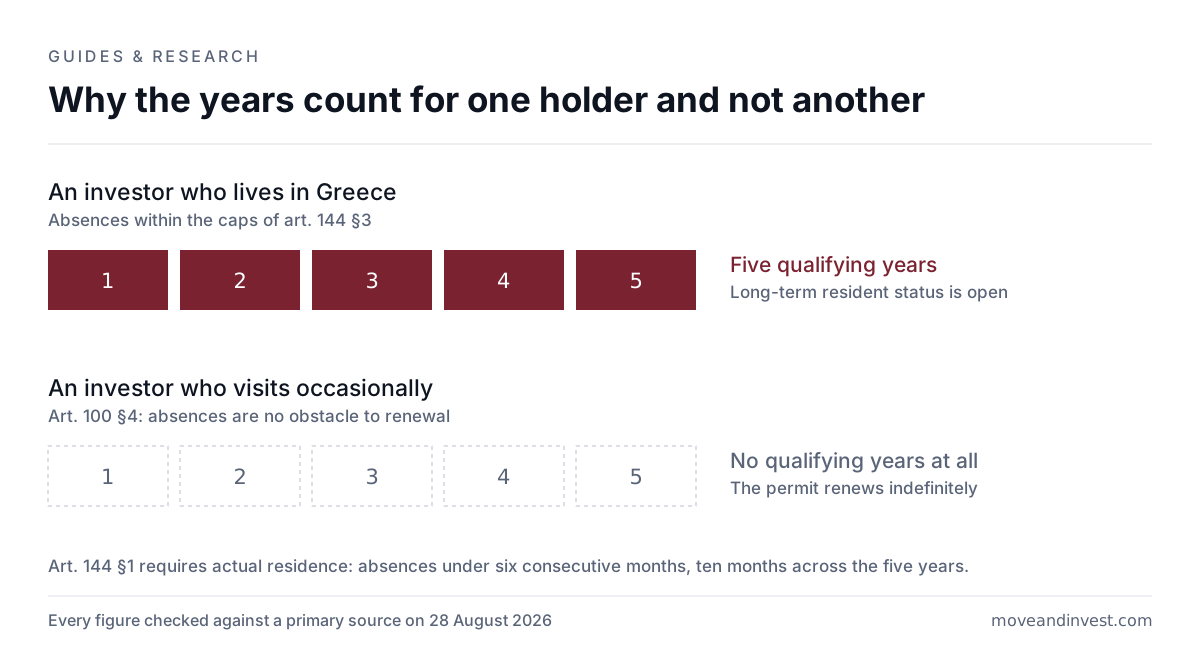
So the same card behaves in two different ways depending on what its holder does. An investor who does not live in Greece renews it indefinitely and accumulates no qualifying years at all. An investor who lives in Greece accumulates them exactly like anybody else. The permit is not the variable. Presence is.
The one clause that could argue the other way, and where it comes from
Article 143 §2(e) puts holders of a «προσωρινό καθεστώς διαμονής», a temporary residence status, outside the chapter. That is the single textual hook an authority could use to exclude an investor, so it is worth knowing what it is a copy of.
Article 143 transposes article 3 of Directive 2003/109/EC, and the directive's own exclusion, at article 3(2)(e), covers third-country nationals residing "solely on temporary grounds such as au pair or seasonal worker". Those are the examples the European legislator chose. They describe a purpose that is temporary by design, not an investment.
Against that reading stands the name of the permit itself: «μόνιμη άδεια διαμονής επενδυτή», a permanent investor residence permit. It reads badly as a temporary status.
*What we could not establish: any official statement, circular or decided case saying in terms that investor years count. The structure above is what the statutes say; an express confirmation is a thing we looked for and did not find.*
Greek permanent residence: Μ.1 after five years and Μ.2 after ten
| Μ.1, EU long-term resident | Μ.2, national ten-year permit | |
|---|---|---|
| Period | 5 years, lawful and uninterrupted (art. 144 §1) | 10 years, continuous, under a definitive title (art. 161 §1(a)) |
| Absences | Under 6 consecutive months each, 10 months total | Not two consecutive years |
| Income | Minimum wage annualised, plus 10% for dependants | None stated at grant |
| Greek | Yes, B1, or the alternatives below | Yes, by the same route |
The absence of an income test on Μ.2 is not an oversight to be corrected by a helpful page: article 161 §1(a) imports only point (c) of article 144 §1, the integration condition, and not point (a), the income condition. Article 161 §3 asks for full medical cover and no two-year absence. Income returns at §5, on conversion to Μ.1 when the ten-year permit expires.
There is a second Μ.2 route in §1(b) that has nothing to do with time or money: born in Greece, or six grades of a Greek school completed in Greece, before the applicant's 23rd year.
The difference between the two statuses is not only the waiting time. Μ.1 is Greece's implementation of Directive 2003/109/EC, and that directive is what carries the status across borders. Article 14(1): *"A long-term resident shall acquire the right to reside in the territory of Member States other than the one which granted him/her the long-term residence status, for a period exceeding three months, provided that the conditions set out in this chapter are met."* Article 14(2) names the grounds — employed or self-employed work, study or vocational training, and other purposes — and article 15 lets the second state require an application within three months of entry, stable and regular resources, sickness insurance, and its own integration measures. Denmark and Ireland are not bound by the directive.
Μ.2 is a national permit and carries none of that. It is a longer wait for a status that stops at the Greek border.
Greek language requirement for permanent residence, and the new twelve-year alternative
Article 160 §1(d) accepts a certificate of Greek «επιπέδου τουλάχιστον Β1» — level B1 or above. Under §2, a holder of an A or A2 certificate can qualify by additionally certifying knowledge of Greek history and culture.
Article 37 of Law 5275/2026 added a route in February 2026 that removes the language requirement entirely, and we have not found it on any competing page. Article 160 §1 now also accepts «στοιχεία, σύμφωνα με τα οποία διαμένουν νόμιμα στην Ελλάδα για δώδεκα (12) συναπτά έτη» — evidence of twelve consecutive years of lawful residence in Greece. Twelve years now substitutes for the certificate. The same amendment added a degree from a Greek higher-education programme taught principally in Greek.
The Μ.1 income requirement: the formula, and the figure nobody can quite publish
Article 144 §1(a) sets no euro amount. It sets a formula: not less than «τις ετήσιες αποδοχές του αμειβόμενου με τον κατώτατο μισθό, προσαυξημένο κατά δέκα τοις εκατό (10%) για το σύνολο των συντηρούμενων μελών».
Note 10% for the totality of the dependants, not 10% each. That is widely misreported and it is a real difference for a family of four.
The minimum wage is set by KYA 8934/2026, ΦΕΚ Β΄ 1759 of 27 March 2026, at €920.00 a month from 1 April 2026, up from €880.
Neither instrument says whether "annual earnings" means twelve payments or fourteen — and Greek minimum-wage employment conventionally runs to fourteen, being twelve salaries plus a Christmas bonus, half at Easter and half as a leave allowance. The gap between the two readings is about €1,840.
There is a way to settle what the ministry itself means, and it is arithmetic rather than opinion. The Ministry of Labour puts the cumulative increase since 2019 at €3,780 a year. The 2019 wage was €650 and the new one is €920, a difference of €270 a month. €270 × 14 = €3,780 exactly. €270 × 12 = €3,240. The ministry's own figure is computed on fourteen payments.
On that basis annual minimum-wage earnings are €12,880, and the article 144 threshold with any number of dependants is €14,168. We publish the working rather than the conclusion, because what the arithmetic establishes is the convention, not that the Decentralised Administration deciding your file applies it to this article. That last step is unconfirmed and we are not going to pretend otherwise.
Greek citizenship after seven years: the naturalisation period and the examination
Naturalisation under Law 3284/2004 requires seven years of lawful residence for the holder of an investor permit — the Code has three tiers, and this is the middle one: three years for EU nationals and a few family categories, seven with a title on the list of article 5(1)(ε), twelve under article 5(3) with any other non-temporary title. The application fee is €550 and the examination fee €150. The examination, the ΠΕΓΠ, tests Greek at B1 together with history, geography and culture, with a pass mark of 70%.
The thing to take from this section is that Greece runs three separate clocks and almost every guide melts two of them together:
- the permit's own renewal conditions, where for an investor absence is explicitly irrelevant;
- the permanent-residence count, which is five or ten years of actual presence with capped absences;
- the naturalisation period, which is seven years and has its own examination.
A page that tells you "seven years to citizenship on a golden visa" without mentioning that the years must be spent somewhere has skipped the only part that was ever difficult.
Greek non-dom tax regime: article 5A and the €100,000 flat tax
Three separate regimes live in the Income Tax Code, Law 4172/2013, and they are constantly confused with one another. Their Greek names are 5Α, 5Β and 5Γ; we write them 5A, 5B and 5C throughout, which is how the Greek tax authority renders them in its own English material.
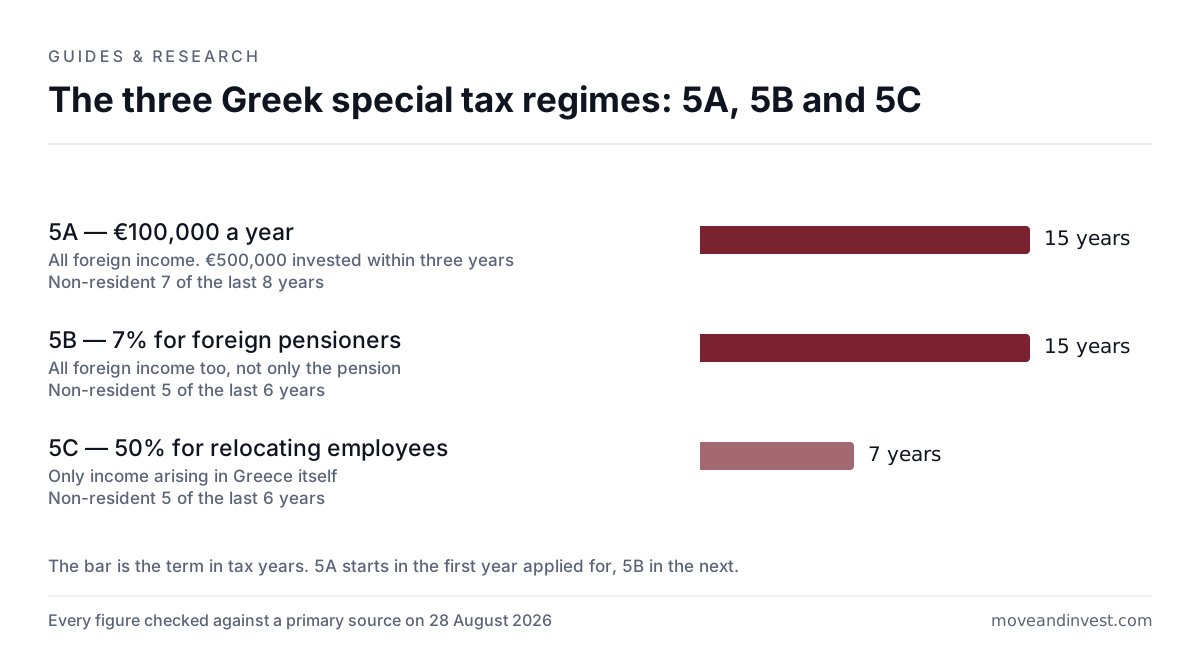
Article 5A applies a flat €100,000 a year to all foreign income, whatever its size, for fifteen tax years, with €20,000 for each additional family member brought into the regime. Two conditions:
- not tax resident in Greece for seven of the last eight years — this is the one most often misquoted as five of six, which is the test for the other two regimes;
- an investment of at least €500,000 in Greek real estate, businesses, securities or shares, completed within three years of the application, made by the taxpayer, a relative, or a legal person in which they hold the majority.
Under §4 it begins from the first tax year applied for.
Greece 7% tax for foreign pensioners: article 5B requirements and the 31 March deadline
Article 5B is the pensioners' regime, and the single most misstated fact about it is what the rate covers.
The rate is 7% «για το σύνολο του εισοδήματός του που αποκτήθηκε στην αλλοδαπή» — on the whole of the income acquired abroad, not only on the pension. The pension is what gets you in; the rate then applies to everything foreign.
The conditions:
- not tax resident in Greece for five of the last six years;
- relocating from a state with an agreement on administrative cooperation in tax matters with Greece — a second condition that most summaries omit entirely;
- fifteen tax years, beginning from the tax year after the one applied for. Note the contrast with 5A, which starts in the first.
Payment is a single instalment by the last working day of December, and paying it «εξαντλείται κάθε φορολογική υποχρέωση» — exhausts the tax obligation on that income. Under §5, failing to pay a year's tax in full loses the regime from that year on, with worldwide taxation under the general rules resuming.
The 31 March deadline is not in the statute. Article 5B §9 delegates it, and the delegated instrument is decision Α.1217/2020, article 4 §1: an application is filed «το αργότερο έως την 31η του μηνός Μαρτίου», with sixty days for the administration to decide. The same date is published by the tax authority for article 5A, though there we have it from AADE's explanatory material rather than from the decision that sets it.
Greece 50% tax exemption for relocating employees: article 5C, and who cannot use it
Article 5C exempts 50% of Greek employment and business income for seven tax years — not fifteen. Its conditions are different again: five of the last six years non-resident; relocating from an EU or EEA state or a cooperation state; providing services in Greece to a Greek legal person or to the Greek permanent establishment of a foreign one; and a declaration of intent to stay at least two years.
This is the one that gets misapplied. You will find the 50% exemption listed as a benefit on pages about the Ι.8 permit for people of independent means. Article 5C taxes income arising in Greece from working there. Article 163 §8(γ) forbids the Ι.8 holder from working there. A benefit conditioned on the one thing your permit prohibits is not a benefit of that permit.
Does a golden visa property count towards the article 5A investment? Yes, at €500,000
This is a question with a genuinely useful answer and we have not found it addressed anywhere else. It also corrects something this site itself published, which is the reason it gets its own section.
Article 5A §1(b) names real estate expressly among the qualifying assets: «σε ακίνητα ή επιχειρήσεις ή κινητές αξίες ή μετοχές ή μερίδια». A property bought for the residence permit is real estate like any other, so it counts.
But it counts at €500,000, and the permit's own thresholds do not line up with that.
| Golden visa tier | Reaches the article 5A floor on its own? |
|---|---|
| €800,000 | Yes, comfortably |
| €400,000 | No, €100,000 short |
| €250,000 conversion or listed building | No, €250,000 short |
So two of the three tiers leave a buyer holding a residence permit and still outside the tax regime on that property alone.
What the permit does not do is excuse the investment. There is a waiver, in the fourth sentence of §1: the §1(b) condition «δεν απαιτείται» for a person who has obtained and maintains a residence permit for investment activity under article 16 of Law 4251/2014. That names one provision.
And article 16 was never the golden visa. It was the permit for investment *activity*; the property permit under the old code was article 20 §Β. The Athens Bar Association's correspondence table between the two codes maps article 16 onto articles 96, 97 and 99 of Law 5038/2023, and article 20 §Β onto article 100. The waiver did not reach a property buyer even when the old code was in force.
*This site previously stated that a golden visa property does not count towards the article 5A investment. That was wrong and has been corrected. The half of the sentence that was right — that the waiver attaches only to the investment-activity permit — is kept.*
Greece golden visa for Russian and Belarusian citizens: what is actually suspended
No English-language page in this market appears to mention this at all, and the Russian-language pages that do are mostly selling a way around it.
New applications are suspended. Renewals are not.
- 28 February 2022: the Ministry of Migration and Asylum announced that issuance and renewal of investment-purpose permits were suspended for citizens of the Russian Federation, «μέχρι νεωτέρας».
- 1 April 2022: a second announcement released renewals — pending and new — for citizens of Russia and Belarus and their family members, while maintaining the suspension of new applications. It carved out Russian and Belarusian family members of investors of other nationalities, and family members of investors already holding valid permits.
- April 2026: a ministry circular is reported to confirm the suspension is still in force and to extend it to change-of-purpose applications under article 12 of Law 5038/2023, closing the route in through a different permit type. *We have that from trade press reading the circular, not from the circular itself, and Greek-language coverage of the same document does not mention the passage. One source, and we are marking it as one source.*
It is not an EU sanction, and it matters that it is not. No Council Regulation or Decision restricts residence by investment for Russian or Belarusian nationals as a class. The instrument behind it is Commission Recommendation C(2022) 2028 final of 28 March 2022, which by its nature does not bind anyone — which is exactly why member states did different things at different times, Italy suspending only in August 2023. It is also a different thing from the suspension of the EU–Russia visa facilitation agreement, which governs short-stay Schengen visas.
The ministry's own figures show the two tracks. In its statistical annex for March 2026, Russia accounts for 458 investor permits in the renewal category, 6.2% of all renewals, plus 725 family-member renewals. Russia does not appear among the top ten nationalities for initial issuance, in a list published down to 1%.
Two things we could not establish. There is no primary instrument: no law, no ministerial decision number, no gazette reference. The restriction appears to exist entirely in announcements and circulars, which is itself worth knowing before planning around it. And the position of the Ι.8 permit is unknown — it is not named in the 2022 decisions, and not being mentioned is not the same as being permitted.
*Some intermediaries market a second citizenship as a way around a nationality-based restriction. We are recording that this is offered, because a reader will meet it. We do not recommend it and cannot advise on it, and anyone weighing it needs independent legal advice about the consequences in every country involved.*
Figures in circulation with no legal source
An audit is only fair if it is specific. These were checked on 28 August 2026 against the searches a reader would actually run.
| Published claim | Where | What the instrument says |
|---|---|---|
| "The minimum investment is €250,000 in Greek real estate in 2026" | Get Golden Visa; Astons uses "from €250K" in its title | €250,000 is two exceptions requiring completed conversion or an unperformed restoration. §2(a) and §2(b) set €800,000 and €400,000 |
| The programme framed under Law 4251/2014 | Get Golden Visa | That code was replaced. The golden visa is article 100 of Law 5038/2023 |
| "50% income tax reduction for up to seven years" listed as a benefit of the income permit | Global Citizen Solutions, FIP page | Article 5C taxes Greek working income. Article 163 §8(γ) forbids the holder from working in Greece |
| "12 years continuous residence required for Greek citizenship" | Lexidy | Our own correction, withdrawn 8 September 2026. Twelve years is a real provision — article 5(3), for a holder of a residence title that is not on the list in article 5(1)(ε). It is not the figure for a golden visa holder, whose permit IS on that list at item αθ and who is on seven. We had read only the seven-year sentence and called the twelve wrong |
| Golden visa "€3,500 a month" and other FIP figures with no decision number | Every FIP page checked | KYA 225679/2024, ΦΕΚ Β΄ 5223/17.09.2024, art. 1 §1(ι) |
| A dedicated heading, "Understanding the Legal Framework", with no law cited anywhere on the page | Global Residence Index | Dash |
The pattern is worth naming, because it is not laziness. Every page in that table carries a recent "last updated" stamp. A timestamp records that a file was touched. It does not record that a number was read against the instrument that sets it, and those are different events.
Frequently asked questions
What is the minimum investment for a Greek golden visa in 2026?
€800,000 in Attica, the Thessaloniki regional unit, Mykonos, Thira and islands above 3,100 inhabitants; €400,000 in the rest of the country. €250,000 exists only for two exceptions — a change of use to residential completed before filing, and a listed building to be restored. All four are set by article 100 §2 of Law 5038/2023.
Does the 120 m² minimum apply to every Greek golden visa property?
No. It appears in §2(a) and §2(b) only, and only where the property is built or has a building permit. Neither €250,000 route states a minimum floor area. What does apply to all four is that the investment must be in a single property.
Can I combine two properties to reach the Greek golden visa threshold?
No. Each of the four points says «σε ένα μόνο ακίνητο» — in one property only. An undivided share counts only where the co-owners are spouses or partners under a cohabitation agreement.
Can I rent out my Greek golden visa property on a short-term platform?
No. Article 100 §7A prohibits letting through the sharing economy, sub-letting, and use as a company seat. Each revokes the permit and carries a €50,000 fine.
Is there a minimum stay for the Greek golden visa?
No. Article 100 §4 states that periods of absence are no obstacle to renewal. But the same absence that does not endanger the permit does prevent the years counting towards permanent residence, which is a separate test under article 144.
Does time on a Greek golden visa count towards permanent residence?
Nothing in the law excludes investors, and the ten-year permit counts any definitive residence title. What the law requires is actual residence: five years lawful and uninterrupted for the EU long-term status, with absences under six consecutive months and ten months in total. An investor who does not live in Greece accumulates no qualifying years, whatever the permit says.
Can I work in Greece on a golden visa or on the Ι.8 permit?
Neither permit gives a right to work in Greece. Article 100 §9 states that the investor permit confers no right of access to any form of employment, and article 163 §8(γ) prohibits both employed work and independent economic activity for the Ι.8 holder and the whole family.
How much income do you need for the Greek FIP visa?
€3,500 a month, plus 20% for a spouse and 15% for each child. That is KYA 225679/2024, article 1 §1(ι) — the statute itself sets no figure. Savings can be used instead, on the strength of the same decision.
Do I need a visa before applying for the Greek Ι.8 permit?
Yes. Article 163 §1 grants the permit to a person who has obtained an entry visa for one of the grounds of that article, so the national type D visa comes first. Its validity runs from 91 days to one year under article 7 §7.
How long until Greek citizenship?
Seven years of lawful residence under Law 3284/2004 for a holder of the investor permit, three for EU nationals and twelve on a title outside the article 5(1)(ε) list, with an examination testing Greek at B1 plus history, geography and culture at a 70% pass mark. Fees are €550 for the application and €150 for the examination.
Do I have to learn Greek for permanent residence?
For the EU long-term status, yes: article 160 §1(d) asks for a certificate at B1 or above, and §2 allows an A2 holder to qualify by adding a history and culture certificate. Since February 2026 there is an alternative — article 37 of Law 5275/2026 accepts twelve consecutive years of lawful residence instead.
Is the Greek 7% tax only on my pension?
No, and this is the most commonly misstated point about it. Article 5B applies 7% to the whole of your foreign income. The foreign pension is the entry condition, not the limit of the rate.
What is the difference between the Greek 5A, 5B and 5C tax regimes?
5A is a €100,000 annual flat charge on all foreign income for fifteen years, requiring seven of the last eight years non-resident and a €500,000 investment within three years. 5B is 7% on all foreign income for fifteen years for foreign pensioners, requiring five of six. 5C is a 50% exemption on Greek working income for seven years, also five of six.
When do I have to apply for the Greek 7% pensioner regime?
By 31 March. That date is not in the statute — article 5B §9 delegates it, and decision Α.1217/2020 article 4 §1 sets it, with sixty days for the administration to decide.
Does my golden visa property count towards the €500,000 investment for the 5A regime?
Yes, if it is worth €500,000 — article 5A §1(b) names real estate expressly. A €400,000 or €250,000 property does not reach the floor on its own. Separately, the waiver of the investment condition applies only to the investment-activity permit of article 16 of Law 4251/2014, which was never the property route.
Can Russian citizens get a Greek golden visa?
New applications have been suspended since 2022 by decision of the Ministry of Migration and Asylum, and renewals of existing permits have not: Russian citizens accounted for 458 renewals, about 6% of the total, in the ministry's March 2026 figures. This is a Greek administrative measure following a non-binding European Commission recommendation, not an EU sanction.
What else here bears on this
Portugal is the other country in this set with a real income route, and it is worked through in its own guide — including the €920 a golden visa investor must also prove, which is the mirror image of the €3,500 above. The income thresholds of all five jurisdictions side by side, with what living in each costs, are in the income piece. What a property purchase achieves in each of the five is in the property piece. What the country is like to live in — what a household actually spends, region by region, and what rent is signed rather than asked — is in the living guide. Who may file the application, on what deadline and on what grounds it stops is in the application guide. The Greek procedure specifically — the fifty days, the apostille, the fee, and what the February 2026 law did and did not change — is in the process guide. Greek citizenship, where three periods apply rather than the one usually printed, is in the citizenship piece. For a reader moving from Britain there is living in Greece from the UK, and for an American, the 1950 tax treaty and the social security agreement are in living in Greece as an American. What the purchase itself is taxed at — why the figure is 3.09% rather than the 3% printed everywhere, what value it falls on, and why the first-home exemption is conditioned on residence and so unavailable to most foreign buyers — is in the transfer tax piece. Every act named above, with the date each was read, is on the sources page.
Sources: where each figure comes from
Every figure above traces to the instrument that sets it. The immigration provisions come from Law 5038/2023 — articles 95, 100, 143 to 145, 160, 161 and 163 — read article by article, together with articles 29, 37 and 38 of Law 5275/2026, ΦΕΚ Α΄ 17 of 6 February 2026. Article 100Α, the startup permit, was added by article 44 of Law 5162/2024, ΦΕΚ Α΄ 198 of 5 December 2024, and its documents are set by KYA 216761 of 12 November 2025, ΦΕΚ Β΄ 6138 of 18 November 2025; the text read for it is the finance ministry's published bill, not the gazette page. Law 5307/2026, ΦΕΚ Α΄ 90 of 11 June 2026, was walked article by article on 5 September 2026 and touches none of the provisions on this page. The €3,500 comes from KYA 225679/2024, ΦΕΚ Β΄ 5223 of 17 September 2024. The minimum wage comes from KYA 8934/2026, ΦΕΚ Β΄ 1759 of 27 March 2026. The tax provisions come from articles 5A, 5B and 5C of Law 4172/2013, with the filing deadline from decision Α.1217/2020 and the implementing decisions listed by AADE. The suspension for Russian and Belarusian citizens comes from the Ministry of Migration and Asylum's own announcements of 28 February and 1 April 2022, and the underlying instrument is Commission Recommendation C(2022) 2028 final.
Seven things on this page are not verified to that standard, and each is marked where it appears. The list of islands above 3,100 inhabitants, which decides the €800,000 zone. Whether an unmarried investor with no partner may bring a parent under article 95 §2(d). Whether the article 144 income formula is applied on twelve payments or fourteen. Any express official statement that investor years count towards permanent residence. The text of the April 2026 circular, which we have through trade press. The body of the ministry's November 2022 clarification, of which we obtained the heading verbatim and the substance in summary. And the position of the Ι.8 permit for Russian and Belarusian citizens, on which nothing is stated in either direction.
One caveat covers all of it. No page of the Government Gazette was read. Greek statutory text here comes from a commercial database that reproduces consolidated law; for article 95 we compared it against the amending law's own wording and the two matched exactly, which is real evidence the reproduction is faithful. It is still a reproduction, and the gazette references beside each citation are what a reader should check against.
Naming those is the point rather than an apology for them. A guide that reads the same whether or not it checked is a guide you cannot use.
We do not sell property and we are not lawyers. This site compares rules and publishes the instrument beside the figure. If you have read the above and want to act on it, the next step is a licensed firm in Greece, and finding you one is what we do.
Does any of this apply to your case?
A guide is research, not advice, and it cannot know your circumstances. Say what you are trying to do and we introduce you to one licensed firm in the jurisdiction concerned — free to you, and only if you tick the box.
Sent.
It is with us. The reply comes from a person and says which firm we think fits and why that one.
That did not go through.
An email address and the consent box are the two things we cannot do without. Everything else is optional.
That is on us.
The enquiry did not reach us — the fault is at our end. Write to office@moveandinvest.com and it will be picked up.