Property
Which countries still give residency for buying property in 2026
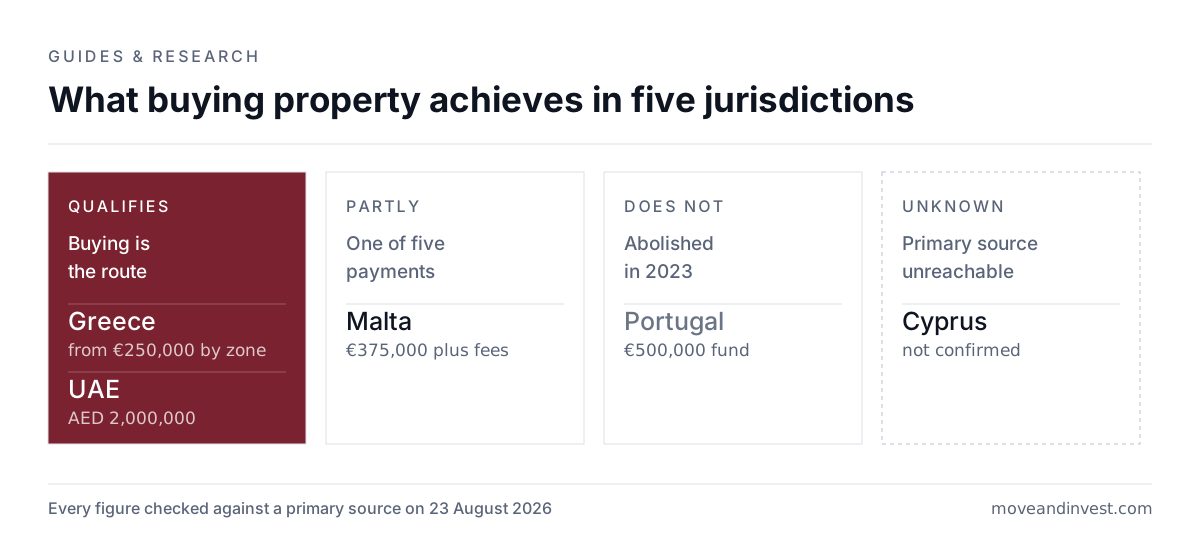
Buying property gets you residency in far fewer places than the advertising suggests. Portugal removed property from its qualifying routes in 2023, Greece raised the threshold to €800,000 across half the country, and on Malta the property is one of five payments rather than the route itself. Five jurisdictions read against the statute: thresholds, the full cost on top of the threshold, real processing times, and the restrictions that get a permit revoked.
Checked against PortugalGreeceMaltaUAECyprusNaturalisation: the column that had to be rewritten
Jurisdictions pt · gr · mt · ae · cy
Contents
- Where property still qualifies: the summary table
- Portugal: the property golden visa is gone, and there is no workaround
- Greece golden visa and real estate: property qualifies, at three thresholds
- Malta: property is required, but it is not the route
- UAE: a ten-year golden visa through property
- Cyprus: why we publish dashes instead of figures
- The full cost: what you need on top of the threshold
- Timelines: what is advertised against what happens
- What comes after the permit: citizenship, stated honestly
- How to choose: three questions before the transaction
- Frequently asked questions
- What else here bears on this
- Where these figures come from
The short answer: of the five jurisdictions this site compares, buying property gets you a residence permit in two — Greece and the UAE. Portugal abolished that route in 2023 and no purchase replaces it. Malta requires property but a purchase alone is not enough: it is one of five mandatory payments and not the largest. For Cyprus we publish no figures, and the reason is below.
Everything else here is the detail that separates the number in the advertisement from the number on the bank statement: thresholds by zone, the cost on top of the threshold, real processing times rather than statutory ones, and the restrictions that cost people their permit.
Where property still qualifies: the summary table
| Jurisdiction | Does buying qualify | Threshold | What is actually required |
|---|---|---|---|
| Greece | Yes, this is the route | €800,000, €400,000 or €250,000 by zone | One property, at least 120 m² of primary space |
| UAE | Yes, this is the route | AED 2,000,000 (about €466,400 at the rate on 23 August 2026) | One or more completed properties totalling the threshold |
| Malta | Partly: property is required, buying alone is not enough | Purchase €375,000 or rent €14,000 a year | Plus €37,000 contribution, €60,000 fee, €2,000 donation |
| Portugal | No, abolished in 2023 | Route is a €500,000 fund subscription | Non-real-estate fund, minimum five years |
| Cyprus | Not confirmed in a primary source | Dash | See the section below |
Portugal: the property golden visa is gone, and there is no workaround
This is the first thing to know if you are reading advertisements for a Portuguese golden visa through real estate. That route has not existed since 2023.
Article 53 of Lei 56/2023 ("Mais Habitação") repealed subparagraphs i, iii and iv of article 3(1) of Lei 23/2007 — both real-estate options and the capital transfer. The part that gets missed is article 3(5) of the same law, which separately prohibits investments directly or indirectly channelled into real estate. So the workaround of "I will subscribe to a fund that invests in housing" is closed too.
What remains is a €500,000 fund subscription (subparagraph vii). The fund must not be a real-estate fund, the term is at least five years, and at least 60% of assets must sit in companies with their seat in Portugal. There are other routes that rarely get mentioned: ten jobs created (eight in low-density areas, with no capital threshold at all), €500,000 into scientific research (€400,000 in low-density areas), €250,000 into cultural heritage (€220,000), and €500,000 into a company creating five permanent jobs.
The €1.5 million capital transfer that still appears in articles no longer exists.
Timelines. The statute (art. 82 of Lei 23/2007) gives 60 days to decide a grant and 30 to decide a renewal, with tacit approval on a renewal where the delay is not the applicant's. In practice a card takes one to three years: submission to biometrics runs 6–24 months, biometrics to card 6–18. As of 4 August 2026, AIMA reports roughly 30,000 pending files. Any article promising "6 to 9 months" is describing the law, not the queue.
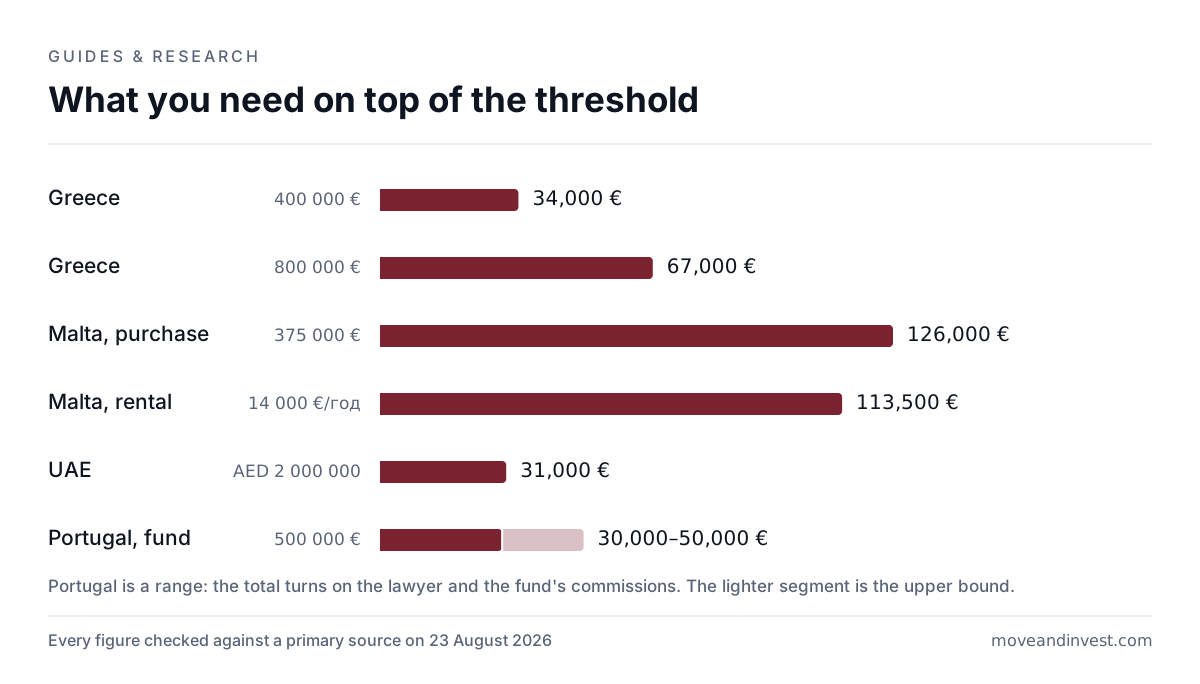
The full cost. AIMA fees from 1 March 2026: €842.80 to process, €8,418.90 to issue, €4,210.30 to renew, €8,418.90 per family member, with a 25% discount for online submission. A single applicant to first renewal is about €13,470 in fees alone; a family of three about €40,400. With a lawyer and fund commissions the real figure is €30,000–50,000 for one applicant and €65,000–90,000 for a family.
Tax. The IFICI regime at 20% exists, but not under the law it is usually attributed to: the basis is article 58-A of the EBF, introduced by Lei 82/2023, not the CIRS code, and the procedure is set by Portaria 352/2024/1 of 23 December 2024. The 20% rate applies to Portuguese-source income in categories A and B from qualifying activity, for ten years, and registration must happen by 15 January of the year following the year residence was obtained. Pensions (category H) and income from blacklisted jurisdictions are excluded and taxed at 35%.
Greece golden visa and real estate: property qualifies, at three thresholds
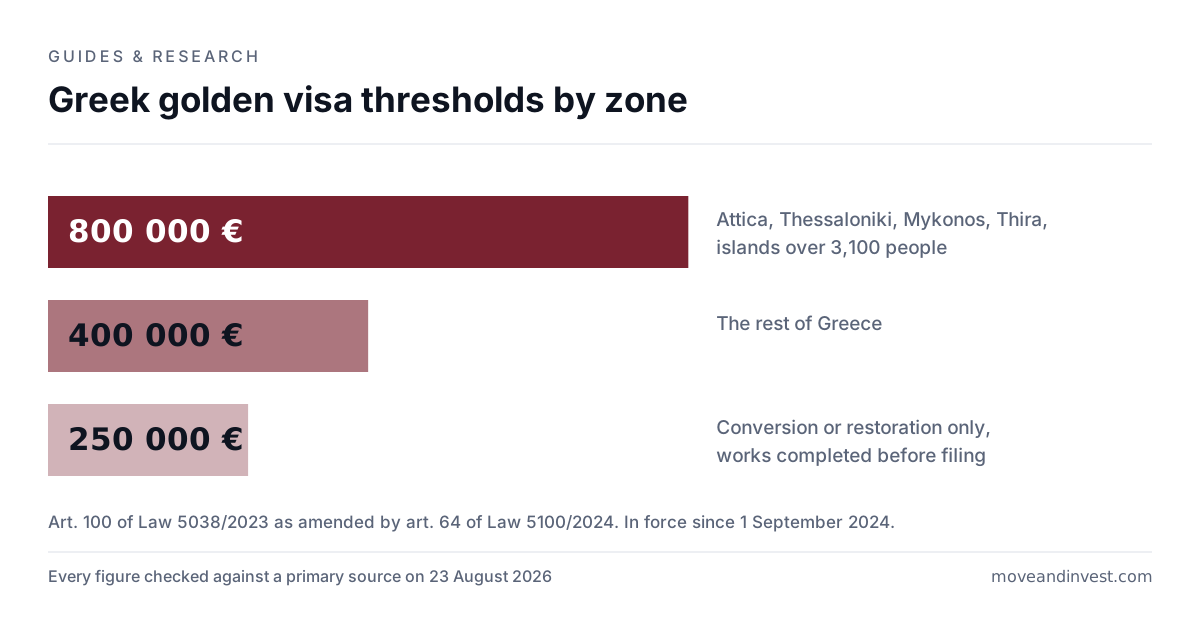
Greece is the one EU country in this set where buying property is itself the route to a residence permit. The provision is article 100 of Law 5038/2023 as amended by article 64 of Law 5100/2024, with the procedure set by joint decision KYA 214926/2025.
The €250,000 threshold still headlining half the market stopped being the general rule on 1 September 2024.
Greek golden visa thresholds by zone
| Threshold | Where it applies |
|---|---|
| €800,000 | All of Attica, the Thessaloniki regional unit, Mykonos, Thira (Santorini) and islands with a population over 3,100 |
| €400,000 | The rest of Greece |
| €250,000 | Only as an exception: conversion of premises to residential use, reconstruction of an industrial building idle for five years, or full restoration of a listed building |
The €250,000 tier deserves its own paragraph, because it is the one most often sold. It is not a cheap region — it is a type of project. And the works must be completed before the application is filed, meaning the buyer funds the entire renovation before holding any status at all.
Two further conditions that almost nobody publishes: the property must be a single one (not two at €200,000 each), and it must have at least 120 m² of primary space.
What you cannot do with a Greek property: revocation and a €50,000 fine
This is the most expensive section in this article, and it does not appear on any of the pages currently ranking for the topic.
Paragraph 7A of article 100 prohibits three things, and each carries revocation of the permit plus a €50,000 fine:
- short-term letting through platforms such as Airbnb or Booking;
- subletting;
- using the property as a company's registered office.
Separately there are €150,000 penalties: for failing the restoration condition under paragraph 4 (without revocation) and for transferring the property contrary to paragraph 2(δ) (with revocation).
The practical consequence: the plan of "buy a studio in Athens, let it nightly, let it pay for itself" does not merely fail to work — it costs the permit and €50,000 on top. Long-term letting is not caught by the ban, but its yield is a different proposition entirely, and that belongs in the model before the purchase rather than after it.
Greek processing times and the full cost
The statutory issuing deadline is two months from the complete file reaching the issuing authority, under article 100 §10 — and the queue has run well past it for years. On filing, a βεβαίωση is issued under article 10 of Law 5038/2023, and that document by itself confers lawful stay and the rights attaching to the permit until a decision is made — so waiting does not mean being out of status. As of November 2025 there were 13,499 pending files, 10,703 of them in Attica, with waits reaching 18 months and now shortening.
Costs on top of the €400,000 tier: transfer tax of 3% plus a 3% municipal surcharge on the tax itself, so 3.09%; an e-paravolo of €2,000 per application plus €16 for printing the card. VAT on new builds (24%) is suspended until 31 December 2026, so ΦΜΑ is what is actually paid in practice. The fee per family member is not set in the KYA, so we do not publish one. The total lands around €34,000. At the €800,000 tier the same set comes to about €67,000.
Malta: property is required, but it is not the route
Malta appears in almost every "residency for property" list, and formally that is fair: no application is accepted without a property. In substance the property is one of five mandatory payments, and not the largest.
The programme is the Malta Permanent Residence Programme (MPRP), under S.L. 217.26 to the Immigration Act (Cap. 217), as amended by L.N. 310/2024 (from 1 January 2025) and L.N. 146/2025 of 22 July 2025.
| What is paid | How much |
|---|---|
| Property: purchase or rent | €375,000 anywhere on the islands, or €14,000 a year |
| Government contribution | €37,000 on either route |
| Administrative fee, main applicant | €60,000 |
| NGO donation | €2,000 |
| Per dependant | €7,500 |
| Card | €500 each |
A spouse, minor children and adult children with a disability are included at no charge. The property must be held for five years. There is also an asset test: €500,000 of which €150,000 financial, or €650,000 of which €75,000 financial.
The €300,000 threshold that still circulates is the old figure for the south of Malta and Gozo before the reform. There is no regional difference any more.
The full cost. Stamp duty is 5% of the higher of price and market value (1% provisionally on the promise of sale). On the purchase route the main applicant pays roughly €126,000 on top of the property price. On the rental route it is about €113,500 in the first year, and roughly €190,000–205,000 across five years of rent.
Timelines. Residency Malta publishes no processing time at all; the agents' handbook (v4.0, 28 January 2025) says only "reasonable timeframes". Meanwhile eight months are allowed to complete the purchase and payments after the letter of approval in principle — which makes the widely advertised "4 to 6 months to a card" arithmetically impossible. Six to twelve months end to end is realistic.
Tax. A resident without domicile pays on foreign income only when it is remitted to Malta, and foreign capital gains are not taxed even on remittance. There is a minimum tax of €5,000 a year where unremitted foreign income reaches €35,000. Worth stating plainly: the MPRP does not by itself confer tax residence.
UAE: a ten-year golden visa through property
The second case where buying is the route. The bases are the DLD service "Request for Golden Visa – Investor" and the GDRFA service "Issuing a golden residence permit (investors)".
The threshold is AED 2,000,000 for a ten-year visa. At the rate on 23 August 2026 (about 4.288 dirhams to the euro) that is roughly €466,400. We give the rate with its date deliberately: a euro figure without a date is wrong within six months.
Three clarifications that the listicles omit:
- The property need not be a single one. GDRFA's own wording is "one or more properties with a total value of not less than AED 2,000,000".
- A mortgage is allowed, with a no-objection letter from the bank stating the amount paid and the balance.
- Fractional ownership qualifies where the share itself meets the threshold.
Off-plan property. No official page states that a property under construction qualifies for the golden visa, and the GDRFA owner-visa page expressly requires completed construction. We assert neither: this is a question the primary source does not answer, and an off-plan buyer should get confirmation before the transaction rather than after it.
On AED 750,000 and AED 1,000,000. A AED 750,000 threshold cannot be found in any current source. AED 1,000,000 is the retirement golden visa from age 55 for five years, not a shorter investor visa.
Timelines. DLD publishes 7–10 working days, GDRFA about 5 working days, and ICP issues an entry permit in 2 days. Realistically, title deed to Emirates ID runs about two to four weeks. This is the only jurisdiction in the set where the advertised timeline is close to the actual one.
Cost on top of the threshold. Government fees for the golden visa come to AED 9,884.75 (medical 700, Emirates ID 1,153, residence 2,856.75, DLD 4,020, administrative 1,155), plus AED 5,774.50 per dependant. The DLD registration fee of 4% and the agent's commission of 2% are market practice not confirmed by an official page; including them, the total lands near €31,000.
Tax. The government portal u.ae states it directly: "The UAE does not levy income tax on individuals". Corporate tax at 9% and the 15% DMTT do not reach personal income. VAT is 5%.
Cyprus: why we publish dashes instead of figures
For the Cypriot 6(2) route, secondary sources give a €300,000 threshold excluding VAT, a requirement of €50,000 a year in verified foreign income plus €15,000 for a spouse and €10,000 per minor child, health insurance, and annual confirmation that the investment is retained.
We could read none of it in a primary source: gov.cy returns 403, the certificate on mip.gov.cy has expired, and the tax department's PDF is closed to reading. So Cyprus sits in our tables with dashes and has no page of its own.
One Cypriot point we did establish, and it changes the budget: transfer fees are not charged where VAT has been paid, and the 6(2) route requires a first-sale property, which carries VAT. So they come out of the calculation. Where they do apply, the rates are 1% up to €85,000, 3% up to €170,000, and 5% above.
The full cost: what you need on top of the threshold
| Jurisdiction | Threshold | On top | What that covers |
|---|---|---|---|
| Greece, €400,000 tier | €400,000 | about €34,000 | ΦΜΑ 3.09%, e-paravolo €2,000, card €16 |
| Greece, €800,000 tier | €800,000 | about €67,000 | the same set |
| Malta, purchase | €375,000 | about €126,000 | stamp duty 5%, €60,000 fee, €37,000 contribution, €2,000 NGO, card |
| Malta, rental | €14,000 a year | about €113,500 in year one | no stamp duty |
| UAE | AED 2,000,000 | about €31,000 | fees of AED 9,884.75 plus market 4% and 2% |
| Portugal, fund | €500,000 | €30,000–50,000 for one | AIMA fees, lawyer, fund commissions |
Timelines: what is advertised against what happens
| Jurisdiction | Advertised | Actual |
|---|---|---|
| Greece | 2–4 months | Statute gives two months (art. 100 §10); the queue does not — 13,499 files as of November 2025, up to 18 months |
| Portugal | 6–9 months | Statute gives 60 days for a grant; one to three years in practice, about 30,000 files queued |
| Malta | 4–6 months | No published time; 6–12 months end to end |
| UAE | 3–6 weeks | 2–4 weeks from title deed to Emirates ID |
What comes after the permit: citizenship, stated honestly
More changed here in 2026 than anywhere else, and last year's listicles are now wrong.
Portugal has stopped being the fast route to a passport. Lei Orgânica 1/2026 (published 18 May 2026, in force from 19 May) rewrote article 6(1)(b): seven years for citizens of Portuguese-speaking countries and the EU, ten years for everyone else. Plus an examination in language and in culture, history and state symbols, plus a solemn declaration. It is not retroactive: files submitted before it came into force are decided under the previous version. Article 5 of the same law also repeals article 15(4), under which the wait for a residence permit had counted towards the period since March 2024 — so for anything filed from 19 May 2026 the queue no longer counts, while a file already pending keeps the old counting.
Greece: a golden visa does not by itself accumulate the period. The Citizenship Code (art. 5(1)(δ) of Law 3284/2004) requires seven years of continuous lawful residence. The investor permit is a qualifying title, but the Code requires actual residence and the golden visa imposes no minimum stay. A person can hold the permit for ten years without living in the country and be no closer to citizenship.
Malta: citizenship by investment is closed. Following the Court of Justice ruling in C-181/23 of 29 April 2025, the scheme was replaced by Act XXI/2025 and the S.L. 188.06 rules: naturalisation for merit in science, sport, culture and philanthropy, with residence of at least eight months. Payment alone does not qualify. Ordinary naturalisation is four years out of the last six plus twelve continuous months before applying.
UAE: naturalisation is exceptional and by nomination; owning property does not begin it.
The honest column heading for any comparison is not "path to citizenship" but "naturalisation by residence is possible". In every case it requires real, multi-year residence and a language examination.
How to choose: three questions before the transaction
One: do you need the status or the yield? If the property has to pay for itself through nightly letting, Greece is out — there it costs the permit and €50,000. If only the status matters, the Greek €400,000 tier remains the cheapest entry into the EU in this set.
Two: is a passport part of the plan? If so, a golden visa without residence leads nowhere. Portugal's ten years and Greece's seven are counted from actually living there.
Three: where will tax residence sit? That is a separate question from the permit, and on Malta the MPRP does not confer tax residence at all.
Frequently asked questions
Can you still get a Portuguese golden visa by buying property?
No. Article 53 of Lei 56/2023 repealed both real-estate options in 2023, and article 3(5) separately prohibits investment channelled indirectly into real estate. What remains is a €500,000 non-real-estate fund.
What does a Greek golden visa cost in 2026?
The threshold depends on the zone: €800,000 in Attica, Thessaloniki, Mykonos, Thira and the larger islands; €400,000 elsewhere; €250,000 only for conversion or restoration projects, with the works completed before filing. On top of the threshold, roughly €34,000 at the €400,000 tier and €67,000 at the €800,000 tier.
Can you rent out a Greek property bought for the golden visa?
Long-term, yes. Short-term through Airbnb, Booking and similar, no: paragraph 7A of article 100 brings revocation of the permit and a €50,000 fine. Subletting and use as a company's registered office are treated the same way.
Does the threshold have to be met with one property or several?
In Greece it must be a single property of at least 120 m² of primary space. In the UAE several properties may be combined — GDRFA expressly allows "one or more".
Does off-plan property in the UAE qualify for the golden visa?
No official page confirms that it does, and the GDRFA owner-visa page requires completed construction. Get confirmation before the transaction.
Can you buy with a mortgage in the UAE and still get the visa?
Yes, with a no-objection letter from the bank stating the amount paid and the balance outstanding.
Is buying property on Malta enough on its own?
No. The property is required, but alongside it come a €37,000 government contribution, a €60,000 administrative fee, a €2,000 NGO donation and €7,500 per dependant, plus an asset test from €500,000.
Why do you show dashes for Cyprus when others publish figures?
Because the primary sources were unreachable when we checked: gov.cy returns 403 and the certificate on mip.gov.cy has expired. A threshold published without reading the law travels further and is never retracted. The figures will appear when the source opens.
Does a property residence permit allow work and study across the EU?
The permit is valid in the issuing state; Schengen movement and rights in other member states are a separate question answered by each country's own law.
How long does a decision actually take?
Greece's statute gives two months and its queue held 13,499 files in November 2025. Portugal's statute gives 60 days for a grant but takes one to three years against roughly 30,000 pending files. The UAE takes two to four weeks.
What else here bears on this
Two of the five jurisdictions in this piece have a guide of their own. What Portugal asks a resident to prove, and what its ten-year citizenship clock changed, is worked through in the Portugal guide. What Greece asks, and why permanent residence there counts days rather than permits, is in the Greece guide. The income question that runs under all five — who tests it, who does not, and what living in each actually costs — is a piece of its own. The Emirates, the other jurisdiction here where a purchase is the whole route, has a guide of its own. Malta, where the property is a condition rather than the investment and the real money is the contribution beside it, has one too. Once a route is chosen, who may file the application and what each portal asks for is in the application guide, and what follows a Portuguese permit — renewals, the card, permanent residence — is in its own guide. If the phrase itself is the question, what a golden visa actually is is a page of its own. For a reader who has not settled on a country at all, the same five are compared by the income each demands and by the two clocks that follow in the best country to move to from the USA. Two of these purchases now have a page about what they cost rather than what they achieve: Portugal, where a non-resident pays a flat 7.5% with no relief, and Greece, where the transfer tax is 3.09% and the first-home exemption needs residence. What the law allows once the property is yours and you want to let it out by the week is in the short-term rental rules. Two tools here compute the money rather than describe it: what the state takes at the deed in each of the four, at your own price, is in the property transfer tax calculator, and what entry to each programme costs once taxes, contributions and permit fees are added to the advertised minimum is in our cost of entry calculator. And every act named above, with the date each was read, is on the sources page.
Where these figures come from
Every figure in this article is checked against a primary source — a statute, a regulation or an authority page — and each carries its article number. The full list with links and the date each was read is on our sources page, which also records where the primary source was unreachable and why a dash appears in the table instead of a number.
We compare rules and do not provide legal services: none of this is legal or tax advice. If you want someone to check your own position against the letter of the law after comparing, we will find you a licensed lawyer in the relevant jurisdiction and a vetted property agent, and pass your enquiry to them directly.
Does any of this apply to your case?
A guide is research, not advice, and it cannot know your circumstances. Say what you are trying to do and we introduce you to one licensed firm in the jurisdiction concerned — free to you, and only if you tick the box.
Sent.
It is with us. The reply comes from a person and says which firm we think fits and why that one.
That did not go through.
An email address and the consent box are the two things we cannot do without. Everything else is optional.
That is on us.
The enquiry did not reach us — the fault is at our end. Write to office@moveandinvest.com and it will be picked up.