Relocation
Malta permanent residence programme in 2026: the cost, the presence rule, and what replaced the passport
Malta sells three different things under one word. The permanent residence programme costs about €126,000 above the price of a property and publishes no rule about how long you must be on the island. The nomad permit costs a fraction of that and will not renew unless your bank statements prove five months a year. The expensive route asks for your money and nothing else; the cheap one asks for your time. That is the opposite of how both are sold.
Checked against MaltaNaturalisation: the column that had to be rewritten
Jurisdictions mt
Contents
- Malta residency options in 2026: the three routes compared
- Malta permanent residence programme cost in 2026: every line of it
- What you owe every year afterwards, which no brochure we read mentions
- How long must you actually be in Malta on the MPRP?
- The other Maltese route, and why it inverts this one
- Malta tax residence: 183 days, and what "non-dom" actually gets you
- The Global Residence Programme, and the rules that replace it on 1 January 2027
- What happened to the Maltese passport: C-181/23, Act XXI of 2025, and the regulations that were not replaced
- Maltese citizenship by naturalisation: the arithmetic is not five years
- Malta for Russian and Belarusian citizens: suspended by press release
- Figures in circulation with no legal source
- Frequently asked questions
- What else here bears on this
- Sources: where each figure comes from
Malta sells three different things and calls all of them residency.
The first is a certificate saying you may live on the island. The second is being taxed by Malta, which is decided by counting your days and not by holding the certificate. The third is a Maltese passport, which stopped being purchasable in 2025 and now asks for eight months of actual residence and publishes no price at all.
Most pages about Malta collapse those three into one product. This one keeps them apart, because the gap between them is where the money goes.
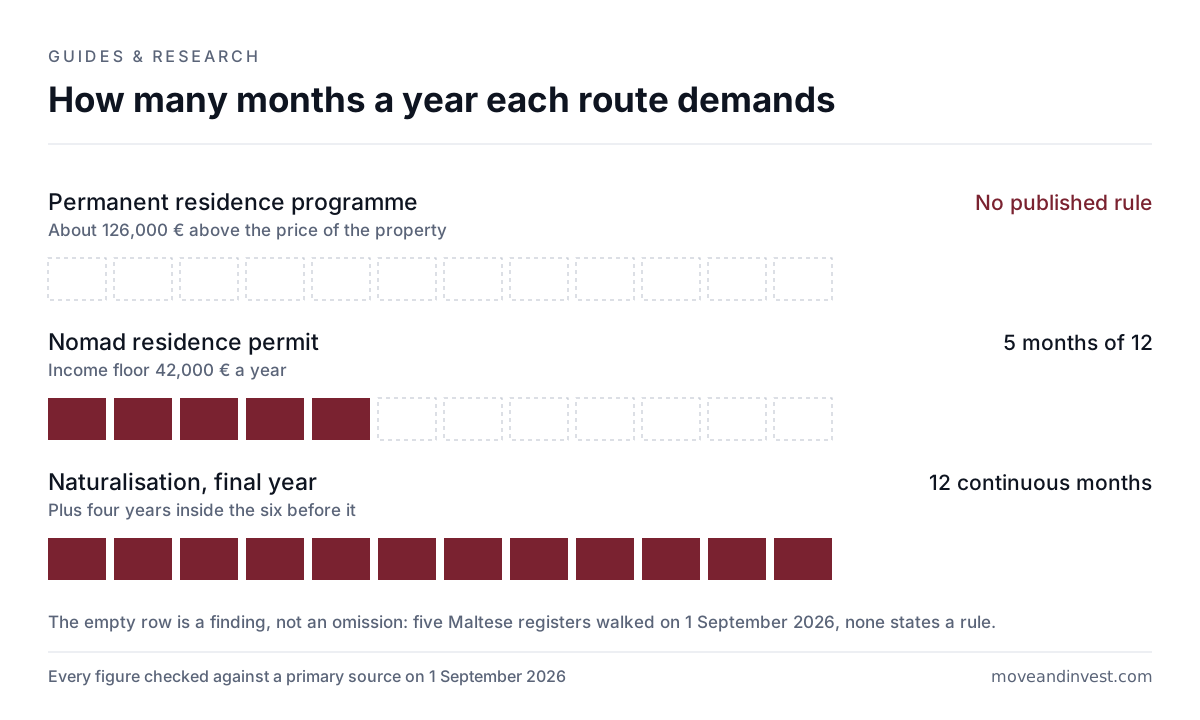
And there is an inversion at the centre of it worth stating before anything else. The programme that costs about €126,000 above the price of a flat publishes no rule about how long you have to be in the country. The permit that costs a few hundred euros will not renew unless your bank statements show five months a year of transactions in Malta. The expensive route wants your money and nothing else. The cheap one wants your time.
Everything below is quoted from the instrument or the agency page that sets it. Where a thing could not be read at source, this guide says so rather than filling the gap from somebody else's page.
Malta residency options in 2026: the three routes compared
| Route | What it asks for | Presence required | Term | Tax effect |
|---|---|---|---|---|
| Permanent residence programme (MPRP) | €375,000 purchase or €14,000 a year rent, plus about €99,500 in fees and contributions | Nothing published | Certificate, property held five years | None by itself |
| Nomad residence permit | €42,000 a year of income earned outside Malta | At least five months in any twelve, evidenced by bank statements | One year, three renewals, four years maximum | 10% on authorised work |
| Global residence programme | Property from €220,000 and a €15,000 minimum tax; from 2027, €700,000 and €35,000 | Not more than 183 days in any other single jurisdiction | Special tax status | 15% on foreign income remitted |
Malta permanent residence programme cost in 2026: every line of it
The programme is the Malta Permanent Residence Programme, made under the Immigration Act (Cap. 217) as Subsidiary Legislation 217.26. Its current figures come from two amendments: L.N. 310 of 2024, in force 1 January 2025, and L.N. 146 of 2025, of 22 July 2025. Residency Malta's own legal framework page lists those two and nothing later, and the legislation portal's consolidated text carries the same date. Read again on 1 September 2026 and unchanged.
The property. €375,000 to buy, anywhere in Malta or Gozo. Or €14,000 a year to rent, anywhere. Held for five years either way.
The €300,000 figure that a good part of the market still quotes is the old threshold for the south of Malta and for Gozo, and there is no regional threshold any more — L.N. 310 of 2024 abolished the discount and raised the single national figure. A page quoting €300,000 in 2026 is quoting a rule that stopped existing at the start of 2025.
Everything else, for a single applicant on the purchase route:
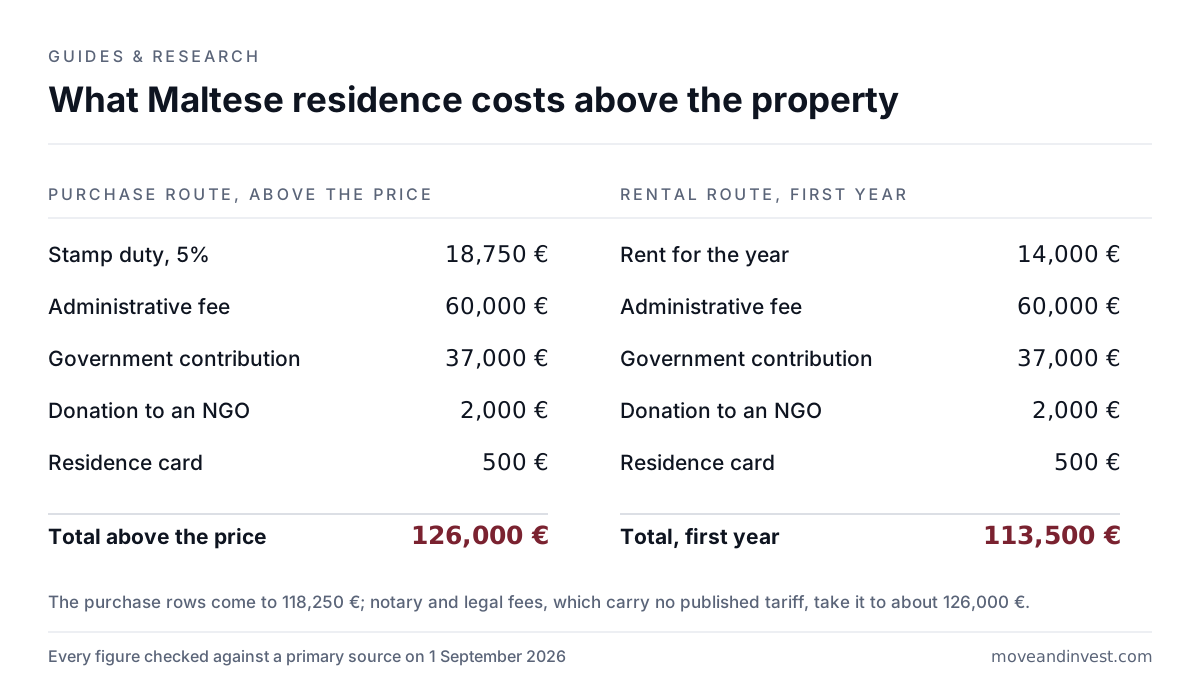
- stamp duty at 5% of the higher of price and market value — €18,750 on a €375,000 property, of which 1% is payable up front on the promise of sale;
- administrative fee €60,000, which L.N. 146 of 2025 turned into a staged payment;
- government contribution €37,000, now the same whether you buy or rent;
- donation to a registered non-governmental organisation €2,000;
- residence card €500 a person;
- €7,500 per dependant, with a spouse, minor children and adult children with a disability free of it;
- and an asset test: €500,000 of which €150,000 financial, or €650,000 of which €75,000.
That is roughly €126,000 above the price of the property once notary and legal fees are added. On the rental route it is about €113,500 in the first year with no stamp duty — and about €190,000 to €205,000 across five years once the rent itself is counted, which is the number the rental route is usually sold without.
What you owe every year afterwards, which no brochure we read mentions
The certificate is not a purchase that ends. Residency Malta's handbook for agents sets an annual compliance obligation: every year for the first five years a beneficiary must produce
> "proof of property lease, via the presentation of a contract of lease, as well as proof of sickness insurance cover"
and thereafter whenever the Agency deems it necessary.
Two things follow. The five-year qualifying property is not a formality you satisfy once at the notary — it is checked annually. And sickness insurance is a recurring cost nobody quotes in the headline, because the headline is built to be compared against Greece and Portugal on entry price.
How long must you actually be in Malta on the MPRP?
Malta does not publish an answer, and that is not the same as there being no rule.
On 1 September 2026 we walked five places where the answer would sit:
- S.L. 217.26 on the government legislation portal — served through a viewer that returns no text.
- The same instrument as Residency Malta publishes it, the consolidated PDF of February 2025 — no machine-readable text layer.
- The handbook for agents — the subject does not appear. The handbook says at §1.3 that "Should there be conflicting views between this Handbook and the legislation, it is the legislation that prevails", which is an agency pointing at a document you cannot read.
- The programme's own frequently-asked-questions PDF — the document that would have answered it. The agency's link returns 404; the file has been withdrawn.
- Residency Malta's "Compliance" page — renders "Nothing Found".
So the honest position is this. Malta publishes no minimum-presence rule for this programme. The regulations may well contain one. Any specific figure a broker gives you for this — "one day a year", "no requirement at all", "you must not be absent more than six months" — is unsourced until somebody produces the regulation, and you are entitled to ask which regulation before you accept it.
What Malta does publish is an absence rule for long-term resident status, which is a different status, and a rule for family-reunification permits whose holder is "spending the majority of their time residing in another country". Neither is addressed to an MPRP beneficiary. Schengen travel is the ordinary permit-holder rule: visits to other European countries "provided that the total period of the visit/s does not exceed 90 days within a 180-day period".
The other Maltese route, and why it inverts this one
The Nomad Residence Permit is the cheap way into Malta and the only Maltese route whose renewal is decided by where you actually were: €42,000 a year earned outside Malta, 10% tax on authorised work, and renewal only against "a bank statement showing payment transactions carried out in Malta as proof that they have resided in Malta for a cumulative period of at least five (5) months over the previous twelve (12) months".
The comparison is the point. The nomad permit demands five months a year in the country and proves it against your bank statements. The MPRP demands about €126,000 and, so far as anything published shows, nothing else. The programme that asks least of your money asks most of your time.
Its ceiling is real, though — four years, and the agency states in terms that it leads to no permanent residence and no citizenship. What it asks, what it forbids, and what happens at the end are set out in the nomad permit guide.
Malta tax residence: 183 days, and what "non-dom" actually gets you
Three separate questions, decided by three separate rules, and the whole Maltese tax pitch depends on nobody noticing they are separate.
Whether you may live in Malta is S.L. 217.26. That is what the MPRP answers.
Whether Malta taxes you is a day count. The tax administration's own words:
> "When an individual is present in Malta for more than 183 days (in any particular year) they will be considered as tax residence in Malta for that year."
What Malta taxes you on is domicile and ordinary residence:
> "Those who are considered as ordinary resident and domiciled in Malta are subject to tax on a worldwide basis, whilst those who are either not domiciled or not ordinarily resident in Malta are only taxable on a remittance basis."
And "A person who lives in Malta on a permanent or indefinite basis is ordinarily resident in Malta."
So the remittance basis — foreign income taxed only when brought into Malta, foreign capital gains untaxed even when brought in — is not something the MPRP grants. It follows from not being domiciled in Malta, which almost every foreign buyer is not. The certificate is irrelevant to it in both directions: you can hold the certificate and be taxed nowhere near Malta, and you can be tax resident in Malta with no certificate at all.
Where the remittance basis applies there is a minimum tax of €5,000 a year once unremitted foreign income reaches €35,000.

The Global Residence Programme, and the rules that replace it on 1 January 2027
There is a fourth thing Malta sells: a special tax status under the Global Residence Programme Rules, S.L. 123.148, for non-EU nationals. This page held back its figures in September because the tax administration's only published guidelines date from 2020. The rules themselves, read on 25 October 2026 in their consolidated text as amended by L.N. 267 of 2014 and L.N. 69 of 2020, carry the same numbers: a home bought for €275,000, or €220,000 in Gozo or the south of Malta, or rented for €9,600 a year, or €8,750; 15% on foreign income remitted to Malta; a minimum tax of €15,000 a year covering the beneficiary and dependants; a €6,000 fee, or €5,500 for a property bought in the south; and the status ends on "more than 183 days in a calendar year" in any other single jurisdiction. The south-of-Malta discount is in the rules, not a document nobody updated.
It is also about to be replaced. L.N. 195 of 2026, the Individual Tax Programme Rules published on 14 July 2026, take effect on 1 January 2027: €700,000 to buy or €14,000 a year to rent, anywhere in Malta or Gozo, an €8,500 fee, a €35,000 minimum tax for global resident status, and a five-year term renewable for €2,500. Applications received by 31 December 2026 keep the old terms until 31 December 2031. What this means for a retiree, and for the separate retirement programme open only to EU, EEA and Swiss citizens, is in retiring in Malta.
What happened to the Maltese passport: C-181/23, Act XXI of 2025, and the regulations that were not replaced
On 29 April 2025 the Court of Justice of the European Union held, in Case C-181/23, *Commission v Malta*, that Malta's citizenship-by-investment scheme was contrary to EU law. The Maltese government's statement the same day said it would study the judgment and bring the framework into line. Buying a Maltese passport ended there.
What replaced it is more interesting than a replacement.
On 24 July 2025, Act XXI of 2025 amended the Maltese Citizenship Act (Cap. 188). Alongside it, L.N. 159 of 2025 amended Subsidiary Legislation 188.06 — and S.L. 188.06 is not new. It has been in force since 20 November 2020: it is the instrument that ran the very scheme the Court condemned. It was not repealed. It was rewritten, under a new name, into the rules for naturalisation on the basis of merit.
What the merit route asks for, under article 10(9) of Cap. 188:
> "exceptional contribution and services or exceptional interest in fields of science and research, technology, sport, entrepreneurship (including job creation), or culture and the arts, as well as philanthropy initiatives"
and
> "at least eight months of residence in Malta"
The formal application must also demonstrate property and knowledge of the language. A separate Office of the Regulator supervises the process under articles 25, 25A and 25B.
And there is no published price. The official statement says only that "Fees that would be established by the Agency apply as regards the processing of the different stages of the application." For a route that replaced a scheme whose entire specification was a price, that is a striking silence — and it means nobody can tell you what it costs without inventing the number.
Payment alone does not qualify. Anyone still marketing "Malta citizenship by investment" in 2026 is selling something that a court held unlawful and a statute has since rewritten.
Maltese citizenship by naturalisation: the arithmetic is not five years
Ordinary naturalisation, under articles 10(1) and 11 of Cap. 188, requires an applicant to have
> "resided in Malta throughout the twelve (12) months immediately preceding the date of application"
and
> "resided in Malta for an aggregate period of a minimum of four (4) years, during the six (6) years preceding the above period"
plus "adequate knowledge of Maltese or English language".
Read that carefully, because "Malta: about five years" — which is what comparison tables say, this site's own included until today — is a floor rather than a picture. Twelve continuous months, and four years inside the six that come before those twelve. Five years of residence at a minimum, and it may be spread across as much as seven.
And here is the trap, and it is exactly the Greek one. Naturalisation counts residence. The programme that sells Maltese residence publishes no minimum presence. Nothing excludes an MPRP holder — the Agency compiles a residence certificate for the applicant like anyone else — but the years have to be years someone actually spent in Malta. Buy the certificate in order to live somewhere else and you accumulate nothing at all, on a clock you may believe is running.
Malta for Russian and Belarusian citizens: suspended by press release
On 2 March 2022 the Parliamentary Secretariat for Citizenship and Communities announced that the Community Malta Agency and the Residency Malta Agency had suspended processing of applications for citizenship and for residence from nationals of the Russian Federation and Belarus, "until further notice", on the ground that "the existent due diligence checks cannot be carried out effectively in the current scenario".
That is a dated government press release. It is not a legal notice, there is no gazette reference, and nothing found on 1 September 2026 lifts it, confirms it or restates it. Four and a half years later, a press release remains the last published word.
Worth stating for what it is: this is more than Greece published for the same decision, where the suspension of Russian and Belarusian applicants has run since 2022 with no law, no ministerial decision and no gazette reference of any kind. Two jurisdictions, one decision, two different degrees of not writing it down. Neither is a rule you can read, and in both cases a reader with one of those two passports has to ask the agency directly rather than trust any page — including this one — about their current position.
Figures in circulation with no legal source
- "€300,000 to buy in the south of Malta or Gozo." The old regional threshold, abolished by L.N. 310 of 2024 with effect from 1 January 2025. There is one national figure now: €375,000.
- "4 to 6 months to the permit." Residency Malta publishes no processing time at all; its handbook speaks only of "reasonable timeframes". Eight months are allowed to complete the purchase and payments after the letter of approval in principle, so four to six months to the card is not a realistic end-to-end figure. Six to twelve months is.
- "Malta citizenship by investment, from €600,000." The scheme it names was held contrary to EU law on 29 April 2025. What exists now is a merit route with a residence requirement and no published price.
- Any specific minimum-stay figure for the MPRP. See the register walk above.
- "Permanent residence means you never deal with the authorities again." Annual compliance for the first five years, and thereafter at the Agency's discretion.
Frequently asked questions
Does the MPRP make me a Maltese tax resident?
No. Tax residence follows from being present more than 183 days in a year, and what you are taxed on follows from domicile and ordinary residence. The certificate answers a different question.
Can I work in Malta on the MPRP?
The programme is a residence certificate rather than an employment authorisation. Employment in Malta is a separate permission and this guide does not cover it.
Is the €375,000 property a good investment?
This site takes no view on that and sells no property. What it can say is that the €375,000 is a threshold rather than a valuation: it is the number that makes the application admissible, not evidence that the flat is worth it.
How long do I have to keep the property?
Five years, and the lease or title is checked annually for those five years.
Can I bring my parents?
Dependants are provided for at €7,500 each, with a spouse, minor children and adult children with a disability exempt from that fee. Which relatives qualify is defined in the regulations, and the definition was among the provisions L.N. 146 of 2025 amended — check the current text rather than an older summary.
Does the nomad permit lead to permanent residence or citizenship?
It runs four years at most and nothing published makes it a route onward. Time spent in Malta is time spent in Malta, but the permit itself ends.
I hold a Russian or Belarusian passport. Can I apply?
The last published position, from March 2022, is that both agencies suspended processing "until further notice". Ask the agency directly. No page can tell you the current position from published sources, because there is no published source more recent than that.
What else here bears on this
Greece is the other EU jurisdiction in this set where the permit and the residence clock come apart, and the mechanism is worked through in its own guide — including the suspension of Russian and Belarusian applicants, which Greece never published at all. What a property purchase actually achieves in each of the five jurisdictions is in the property piece. The income thresholds side by side, with what living in each place costs, are in the income piece. The UAE is the comparison for anyone whose real question is tax rather than a European passport, and it is in its own guide. The nomad permit — what it asks, what it forbids and where it stops — is in its own guide. The card itself, the eight-to-ten-week wait and the fee schedule by basis are in the residence card guide. Whether any of this reaches a passport is in the passport piece, and what the Court of Justice closed, with what stands in its place, is in the citizenship piece. What living in Malta costs, read from the rent register, is in the cost-of-living guide. For a reader moving from Britain there is living in Malta from the UK. The 2026 income tax rates, the remittance basis and the tax on selling Maltese property are in Malta tax for individuals. Every act named above, with the date each was read, is on the sources page, and what has changed in the rules and by which instrument is on the rule-change log.
Sources: where each figure comes from
- Malta Permanent Residence Programme Regulations, S.L. 217.26, as amended by L.N. 310 of 2024 and L.N. 146 of 2025 — thresholds, fees, contribution, holding period
- Residency Malta Agency, legal framework page — confirmation that nothing later than L.N. 146 of 2025 governs the programme
- Residency Malta Agency, handbook for agents — annual compliance, and the absence of a processing time
- Residency Malta Agency, Nomad Residence Permit FAQ, version 14.1 of 17 April 2026 — income floor, renewals, the five-month rule
- Malta Tax and Customs Administration, tax residence — the 183-day test and the worldwide-versus-remittance rule
- Malta Tax and Customs Administration, Nomad Residence Permits (Income Tax) Rules guidelines, 12 March 2026 — the 10% rate and S.L. 123.210
- Global Residence Programme Rules, S.L. 123.148, as amended by L.N. 267 of 2014 and L.N. 69 of 2020, read 25 October 2026 — the thresholds, fees, 15% rate and €15,000 minimum tax
- Individual Tax Programme Rules, 2026, L.N. 195 of 2026, Government Gazette No. 21,686 of 14 July 2026 — the rules in force from 1 January 2027
- Court of Justice of the European Union, Case C-181/23, *Commission v Malta*, judgment of 29 April 2025
- Maltese Citizenship Act, Cap. 188, as amended by Act XXI of 2025; S.L. 188.06 as amended by L.N. 159 of 2025
- Aġenzija Komunità Malta — the merit route, and ordinary naturalisation
- Press release of the Parliamentary Secretariat for Citizenship and Communities, 2 March 2022 — the suspension
Does any of this apply to your case?
A guide is research, not advice, and it cannot know your circumstances. Say what you are trying to do and we introduce you to one licensed firm in the jurisdiction concerned — free to you, and only if you tick the box.
Sent.
It is with us. The reply comes from a person and says which firm we think fits and why that one.
That did not go through.
An email address and the consent box are the two things we cannot do without. Everything else is optional.
That is on us.
The enquiry did not reach us — the fault is at our end. Write to office@moveandinvest.com and it will be picked up.