Costs
Golden visa income requirements, and what each country actually publishes about living costs
The routes that cost the most money test income the least. Greece, Malta and the UAE ask investors to prove nothing about their income; Portugal is the one exception and almost nobody writing about it says so. Every threshold below is quoted from the instrument that sets it, and the cost-of-living half explains why one comparison table would be a lie.
Checked against PortugalGreeceMaltaUAECyprus
Jurisdictions pt · gr · mt · ae · cy
Contents
- Golden visa income requirements: the routes side by side
- Portugal: the D7 income requirement is the minimum wage, and the golden visa does not escape it
- Greece FIP visa requirements: €3,500 a month, and nothing for the golden visa
- Malta digital nomad visa salary requirement: €42,000, and a capital test for permanent residence
- UAE remote work visa requirements: USD 5,000 a month, and nothing to buy in
- Why one living-cost table for these four countries would be a lie
- Which country is cheapest depends on what you have: capital, income or a foreign salary
- Frequently asked questions
- What else here bears on this
- Sources: where each figure comes from
The routes that cost the most money test income the least.
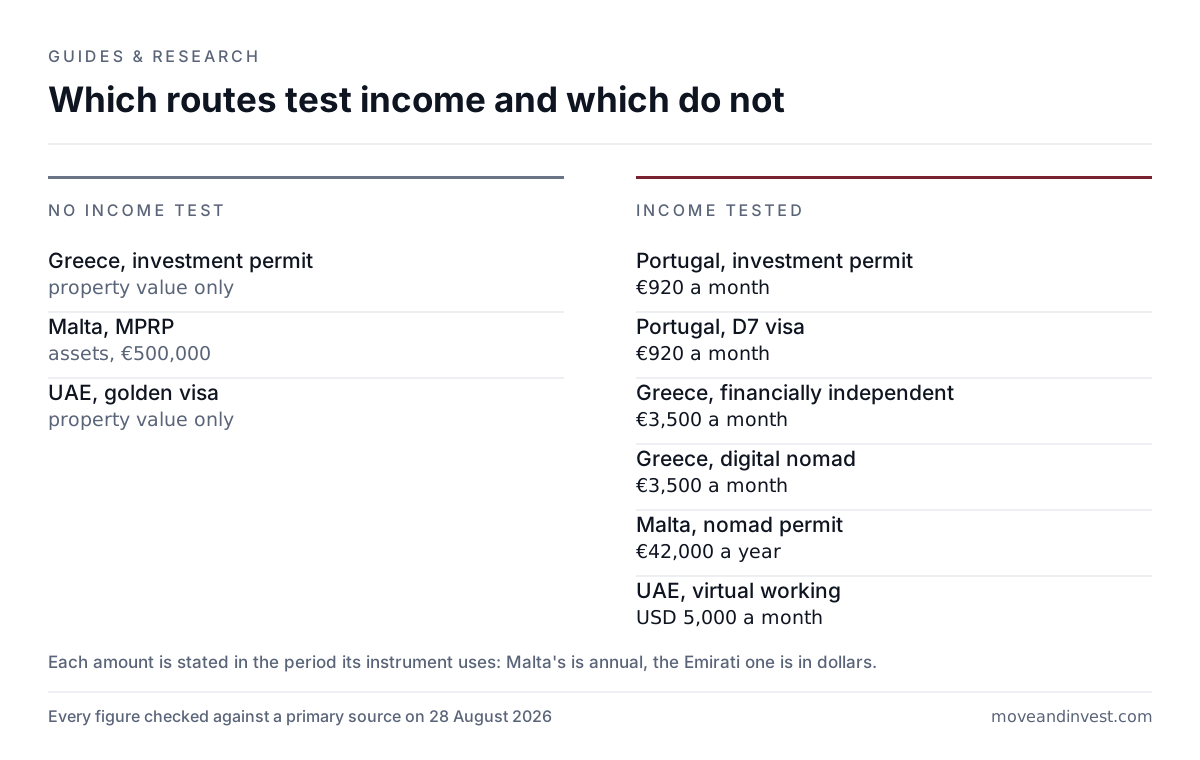
Buy €800,000 of property in Athens and Greece asks you to prove nothing whatsoever about what you earn. Put €500,000 of assets behind a Maltese permanent residence application and the regulations name no income figure at all — only a capital test and an unquantified sufficiency condition. Buy AED 2,000,000 of Dubai property and neither the federal authority nor the Land Department asks for a payslip. But apply to the same three countries as an ordinary person who works remotely or lives off investments, and you will be asked to document between €920 and €3,500 every month, indefinitely.
Portugal is the exception that almost no one writing about golden visas mentions, and it is the single most useful thing on this page: the Portuguese investment permit does not waive the means-of-subsistence test. The article that creates it disapplies exactly one requirement, and that requirement is the visa, not the income.
This piece has two halves. The first is what each jurisdiction makes you prove, quoted from the instrument that sets it. The second is what living there actually costs — and why putting four countries' household spending in one table would be a lie, even though everyone does it.
Golden visa income requirements: the routes side by side
| Jurisdiction and route | Income test | Amount | Where it comes from |
|---|---|---|---|
| Greece, golden visa | None | Dash | Law 5038/2023 art. 100 |
| Malta, permanent residence (MPRP) | None | Dash | S.L. 217.26 |
| UAE, golden visa through property | None | Dash | ICP and DLD service conditions |
| Portugal, investment permit | Yes, not waived | €920 a month | Lei 23/2007 arts. 90-A and 77(1)(d) |
| Portugal, D7 passive income | Yes | €920 a month | Portaria 1563/2007 art. 2(2) |
| Greece, financially independent person | Yes | €3,500 a month | KYA 225679/2024 art. 1(ι) |
| Greece, digital nomad | Yes | €3,500 a month | Law 5038/2023 art. 68(2)(ε) |
| Malta, nomad residence permit | Yes | €42,000 a year | Agency policy, not legislation |
| UAE, virtual working programme | Yes | USD 5,000 a month | u.ae |
Two things in that table are worth more than the numbers.
The first is the word "none". Every competing page handles a route with no income test by saying nothing about income, which a reader cannot distinguish from a page that simply did not cover it. It is worth stating plainly: on the Greek golden visa, the Maltese MPRP and the Emirati property route, no authority will ask what you earn.
The second is the last column. A threshold written into a statute is a different kind of fact from a threshold a government agency publishes on its own website, and only one of them needs a parliament to change it. Malta's €42,000 is the second kind. We say so in the Maltese section.
Portugal: the D7 income requirement is the minimum wage, and the golden visa does not escape it
Portugal sets no euro figure for residence income. It sets a percentage of the national minimum wage and lets that figure move on its own.
Portaria 1563/2007, article 2(2) fixes the scale: 100% of the minimum monthly wage for the first adult, 50% for each further adult, 30% for each child under 18 and each dependent adult child. Article 13 of the same order makes the update automatic, in step with the wage, so no new instrument is issued each year.
Decreto-Lei 139/2025 of 29 December, article 3, sets that wage for 2026: *"O valor da RMMG... é de € 920,00."* It took effect on 1 January 2026.
So, for 2026:
| Applicant | Share of the minimum wage | Per month | Per year |
|---|---|---|---|
| Main applicant | 100% | €920 | €11,040 |
| Spouse or second adult | 50% | €460 | €5,520 |
| Each child under 18 | 30% | €276 | €3,312 |
A couple with one child therefore documents €1,656 a month.
One correction worth making, because it is repeated everywhere. These thresholds are indexed to the RMMG, the minimum wage, and not to the IAS, the social support index. The IAS for 2026 is €537.13, set by Portaria 480-A/2025/1. Anyone quoting an IAS multiple for a Portuguese residence income test is anchoring to the wrong instrument, and the gap between the two is €383 a month.
Does the Portuguese golden visa waive proof of income? No, and here is the text
This is the claim on this page most likely to contradict what you read elsewhere, so it is set out in full.
Lei 23/2007, article 90-A(1)(a) — the investment residence permit — requires that applicants *"Preencham os requisitos gerais estabelecidos no artigo 77.º, com exceção da alínea a) do n.º 1"*: meet the general requirements of article 77, with the exception of subparagraph (a) of paragraph 1.
Article 77(1) lists those general requirements. Subparagraph (a) is possession of a valid residence visa. Subparagraph (d) is *"Posse de meios de subsistência, tal como definidos pela portaria a que se refere a alínea d) do n.º 1 do artigo 52.º"* — possession of means of subsistence, as defined by the order referred to in article 52(1)(d). That order is Portaria 1563/2007, the same one that produces the €920.
The exception in article 90-A is singular and explicit. It removes the visa. It does not remove the income test. An investor is therefore subject to the same means-of-subsistence proof as a retiree on a D7 — which is, in fairness, the lowest income bar of any route on this page.
We checked whether the 2025 reforms changed this. Lei 23/2007 was amended three times in 2025: Lei 9/2025 of 13 February, Lei 55-C/2025 of 22 July and Lei 61/2025 of 22 October. The amendment lists in the first and third name neither article 77 nor article 90-A, and the consolidated text incorporating all three still reads as quoted.
The D8 digital nomad visa: a multiplier, and the euro figure everybody prints instead
Article 61-B of Lei 23/2007 creates the digital nomad residence visa. It requires the applicant to demonstrate the employment relationship or the service contract. It contains no income figure and no multiple of the minimum wage.
The threshold is one level down, in the regulation: articles 18-B(c) and 31-A(1)(c) of Decreto Regulamentar 84/2007 use identical words for the two D8 variants — average monthly income over the last three months of at least four guaranteed minimum monthly wages.
So the number is law, and it is not a number. It is four times the RMMG — €3,680 at the 2026 rate of €920, and a different figure every January. The pages that print "€3,680" without the year or the multiplier are right this year and stale next. Which of the two D8 visas that threshold buys you, and why it matters more than the money, is in the D8 guide.
Greece FIP visa requirements: €3,500 a month, and nothing for the golden visa
Greece runs the widest gap on this page between its investment route and its ordinary ones.
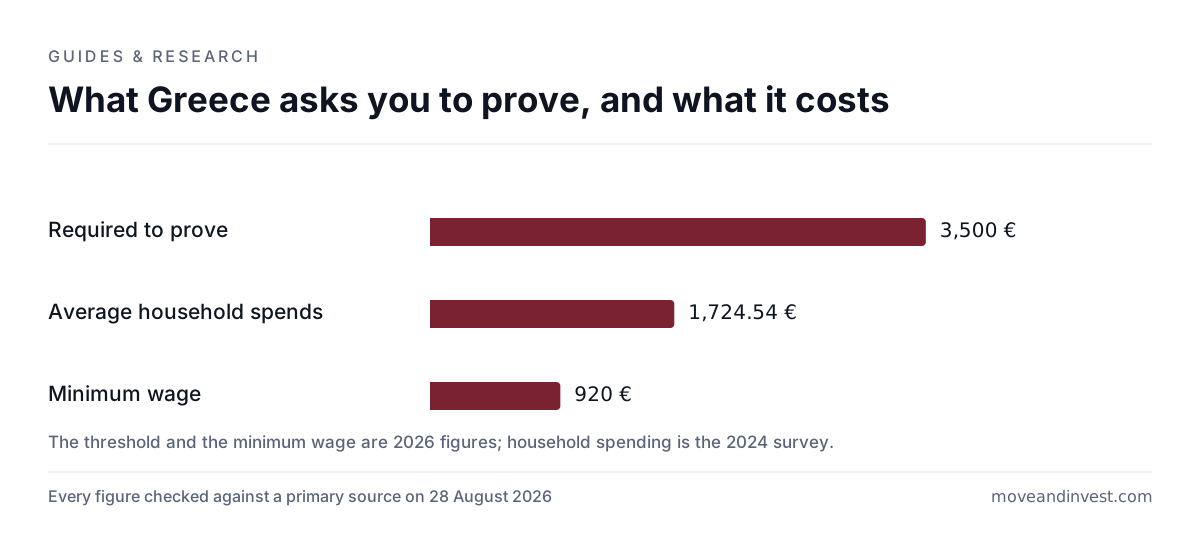
The financially independent person permit requires proof of *«κατ' ελάχιστο τρεισήμισι χιλιάδες (3.500) ευρώ μηνιαίως»* — at minimum three and a half thousand euros monthly. The amount *«προσαυξάνεται κατά 20% για τη σύζυγο και κατά 15% για κάθε τέκνο»*: increased by 20% for a spouse and 15% for each child. The permit sits in article 163 of Law 5038/2023; the figure is set by joint ministerial decision KYA 225679/2024, article 1(ι), gazetted at ΦΕΚ Β΄ 5223 of 17 September 2024.
| Household | Monthly income to prove |
|---|---|
| One applicant | €3,500 |
| Applicant and spouse | €4,200 |
| Applicant, spouse, one child | €4,725 |
| Applicant, spouse, two children | €5,250 |
The digital nomad permit uses the same €3,500 with the same 20% and 15% uplifts, but the figure sits in the statute itself, at article 68(2)(ε) of Law 5038/2023, rather than in a ministerial decision. That is a meaningful difference in how easily it moves.
For scale: the Greek statutory minimum wage from 1 April 2026 is €920 a month, set by ministerial decision 8934 of 27 March 2026 at ΦΕΚ Β΄ 1759. Greece asks a financially independent applicant to prove 3.8 times its own minimum wage.
Greece golden visa income requirement: there is not one
The residence permit for investment in real estate, article 100 of Law 5038/2023, imposes no income test. We confirmed this two ways rather than by absence of mention:
- The text of article 100 contains no reference to income or to sufficient resources.
- mitos.gov.gr, the Greek National Registry of Administrative Procedures — a government source, not a commentary — publishes the document list for the permit. It is title deeds, land registry proof, a notarial certificate, engineer's reports, private health insurance, the E9 property declaration and a photograph. Income evidence is not on it.
The investment thresholds themselves, for context: €800,000 in Attica, Thessaloniki, Mykonos, Thira and islands over 3,100 inhabitants; €400,000 elsewhere; €250,000 for change-of-use conversions and listed buildings.
So the arithmetic of the Greek system is this. Prove €3,500 a month, forever, and you may live there. Or transfer €400,000 once, prove nothing about your income, and you may live there. The second is the expensive option and the undemanding one.
Malta digital nomad visa salary requirement: €42,000, and a capital test for permanent residence
Malta permanent residence income requirement: no figure exists, and what stands in its place
The Malta Permanent Residence Programme is governed by S.L. 217.26, as amended by Legal Notices 310 of 2024 and 146 of 2025. Regulation 9(2) sets a test on capital, not income: the applicant must hold assets *"having a value of not less than five hundred thousand euro (€500,000), out of which a minimum of one hundred and fifty thousand euro (€150,000) shall be in the form of financial assets"*, or alternatively €650,000 of which at least €75,000 is financial.
No euro income figure appears anywhere in the instrument — the word *income* does not appear in it at all. What does appear is [regulation 15(1)(d)](/sources#mt-sl-217-26), a qualitative condition: the applicant must be *"in receipt of stable and regular resources which are sufficient to maintain himself and his dependants without recourse to the social assistance system of Malta"*. That is a means test, and it is unquantified. So the honest statement is not that Malta asks nothing about your income; it is that Malta asks, and publishes no number. Any page printing a euro "MPRP income requirement" is printing something that is not in the law.
The Gozo and southern Malta discount has been abolished
This is the correction most likely to matter to a reader comparing prices, and most of the market has not caught up.
The current regulation 3 defines a qualifying owned property as one purchased *"at a consideration of not less than three hundred and seventy-five thousand euro (€375,000) for a property situated in Malta or Gozo"*, and a qualifying rented property as one *"taken on lease for a rent of not less than fourteen thousand euro (€14,000) per annum for a property situated in Malta or Gozo"*.
One national figure, both islands. The original L.N. 121 of 2021 did differentiate — €350,000 in Malta against €300,000 in the south of Malta or Gozo, and €12,000 against €10,000 in rent — and L.N. 146 of 2025 removed the distinction. Pages still advertising a cheaper Gozo threshold are quoting a superseded instrument.
The rest of the Maltese cost, for completeness: an administrative fee of €60,000, a government contribution of €37,000 — now identical whether you buy or rent, where it once differed sharply — €7,500 per adult dependant and a €2,000 donation to a registered NGO.
The nomad residence permit: €42,000, and it is policy rather than law
Malta's Nomad Residence Permit requires *"a minimum gross yearly income of €42,000"*, with income evidenced for at least five cumulative months before the application. Applicants who applied before 1 April 2024 keep the earlier €32,400.
The threshold is not in any legal notice. The permit's only subsidiary legislation, S.L. 123.210, governs the 10% income-tax treatment rather than eligibility. €42,000 is published by the Residency Malta Agency on its own pages, which makes it an administrative figure. It can change without an instrument being laid before parliament, and it has: it rose by nearly 30% in 2024.
For scale, Malta's statutory minimum wage from 1 January 2026 is €229.44 a week for workers aged 18 and over, which is about €11,900 a year. The nomad permit asks for 3.5 times it.
UAE remote work visa requirements: USD 5,000 a month, and nothing to buy in
The golden visa through property requires property worth at least AED 2,000,000 and imposes no income condition. The federal authority states the requirement as a *"Letter from the Real Estate Registration Department confirming investor's ownership of property worth at least AED 2,000,000"*; the Dubai Land Department states *"The value of the property is 2 million AED, wholly owned by the investor"*. Neither service page lists salary, income or savings among its conditions — only title, a passport valid six months and health insurance.
The virtual working programme, Dubai's remote-work visa, requires employees to *"earn a minimum salary of USD 5,000 per month"*, and company owners to *"have an average monthly income of USD 5,000 per month"*.
If you have read USD 3,500 somewhere, that figure is stale. It is still being republished by pages ranking in the top three for the query. The official page now says 5,000. We could not source the date the change took effect, so we do not state one.
The retirement visa for applicants aged 55 and over with 15 years of prior service is stated by the Dubai residency authority in terms of property of at least AED 1,000,000, a deposit of at least AED 1,000,000, or fixed annual income of at least AED 240,000 evidenced by six months of bank statements. We report those figures with a caveat we cannot resolve: the official page is a machine translation and does not make unambiguous whether the property, deposit and income conditions are alternatives or partly cumulative. Do not plan around a clean "or" without asking the authority.
The UAE has no minimum wage, which removes the reference point
There is no statutory minimum wage in the United Arab Emirates. Article 27 of Federal Decree-Law 33 of 2021 is an enabling power, and its closing words are the ones that matter: *"The Cabinet may, upon the proposal of the Minister and in coordination with the Concerned Authorities, issue a resolution setting the minimum wage for Workers, or any category of them."* The power is exercisable for a sub-group, not only for the workforce as a whole — and we found no Cabinet resolution exercising it generally. Cabinet Resolution 1 of 2022, the executive regulation, contains no minimum-wage article; its article 16, "Wages", governs payment dates and channels only.
The AED 6,000 monthly figure now circulating applies to UAE nationals in the private sector, from 1 January 2026, and it was announced by the labour ministry rather than published as a Cabinet resolution we could locate. Whether it was made under the "any category" limb of article 27 or under the separate Emiratisation framework, we could not establish. Either way it is not a general wage floor, and it does not reach the expatriate workforce this page is about.
That matters for the comparison. In Portugal and Greece, the residence income threshold can be read against a legal minimum wage — one times it in Portugal, 3.8 times it in Greece. In the UAE there is no such denominator, so USD 5,000 a month cannot be placed on the same scale as anything.
Why one living-cost table for these four countries would be a lie
Here is where most pages on this topic stop being useful.
The standard construction puts four countries' living costs in a single table. It cannot be done honestly with national data, and this is why: the four national household budget surveys were run in four different years, by four different offices, on four different methods. Greece's latest wave is 2024. Portugal's is 2022–2023. Malta's is 2015. The UAE has published nothing since 2014. A table of those four numbers looks like a comparison of four countries and is actually a comparison of four vintages.
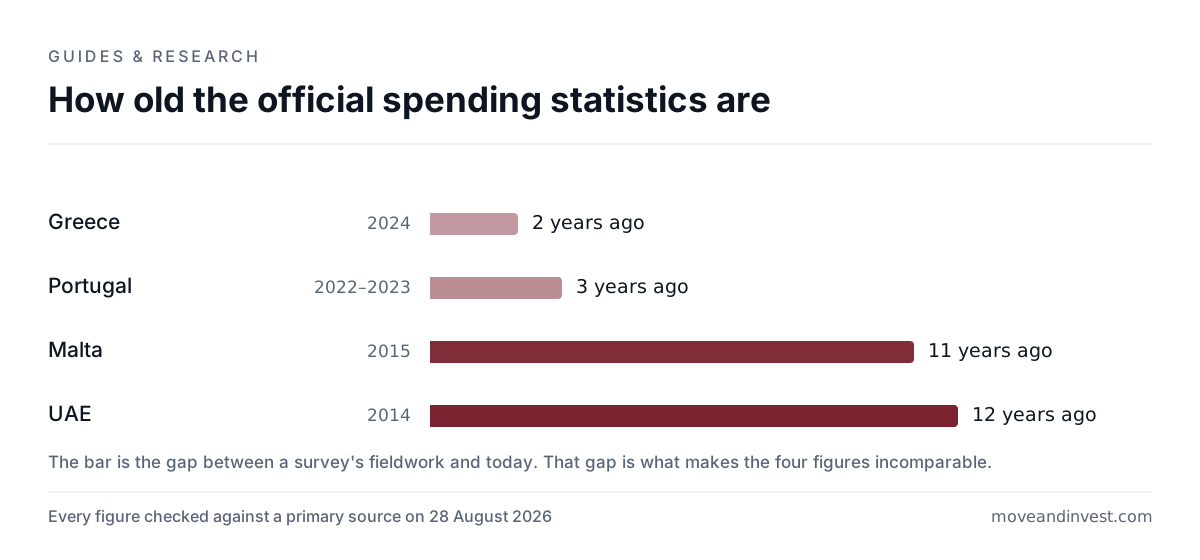
| Jurisdiction | Latest published household spending survey | Fieldwork year |
|---|---|---|
| Greece | Published 25 September 2025 | 2024 |
| Portugal | Published 20 December 2023 | 2022–2023 |
| Malta | Published for the 2015 wave | 2015 |
| UAE | Last published wave | 2014 |
The one comparable measure: Eurostat's price level index
Eurostat's comparative price level index is computed by one office, on one method, for the same year, across all member states. It expresses the price level of household final consumption against an EU average of 100.
| Country | Price level index, EU27 = 100 |
|---|---|
| Greece | 86 (2024) |
| Portugal | 86.6 (2025, preliminary) |
| Malta | 91.9 (2025, preliminary) |
Read that as: Portugal and Greece sit roughly 14% below the EU average price level, Malta about 8% below. Eurostat flags the 2025 round as preliminary and subject to revision when the calculation completes in December 2026, so the two 2025 figures may move.
The UAE cannot be placed on this scale at all. It is not in the index, and there is no equivalent series. Every four-country comparison you will read that includes Dubai has solved this by using a crowdsourced aggregator for all four, which trades comparability for the appearance of it.
Greece publishes €1,724.54 a month, and it is the only current official figure here
The Hellenic Statistical Authority's Household Budget Survey for 2024, published on 25 September 2025 from a sample of 6,198 households, puts average monthly household expenditure at €1,724.54, up 3.6% on the previous year's €1,663.82.
Put that beside the FIP threshold and the comparison becomes concrete: Greece asks a financially independent applicant to prove roughly twice what the average Greek household actually spends.
On rents, Greece publishes direction but not level. Residential rents rose 6.8% in the year to July 2026; the housing group as a whole rose 8.8% and was the largest single contributor to headline inflation of 3.4%. There is no standalone rent index in euros — rents appear only as a consumer-price sub-index — so anyone quoting an average Greek rent in euros is not quoting an official Greek statistic.
Malta publishes an eleven-year-old survey and no rent level at all
Malta's most recent published household budget survey covers 2015 and puts average annual expenditure at €22,346. A new wave ran from November 2024 to November 2025 and had not been published as of 28 August 2026.
We are not going to inflate an eleven-year-old figure to today. That would be interpolation dressed as data, which is the practice this site exists to be the alternative to. The figure is published here with its year attached and nothing else done to it.
Malta publishes rent inflation but no rent level: the rent sub-index rose 3.6% in the year to July 2026, inside a housing group up 6.8% — the fastest-rising group in the index. Its residential property price index, at 104.19 in the first quarter of 2026 and up 6.7% year on year, measures purchase prices rather than rents.
Which produces a genuine oddity worth naming: the MPRP sets a legal rent floor of €14,000 a year, and there is no official Maltese statistic that would tell you whether that is above or below the market.
Portugal publishes both, and we could not read either at source
Portugal's statistical office published the results of its 2022–2023 household expenditure survey on 20 December 2023, and a quarterly median rent series that resumed on 26 June 2026 after being suspended earlier in the year.
We could not open either release. Every route to the office's own server failed at the network level across two attempts on two different days, and the fallbacks — the regional statistics office, the Eurostat household budget dataset, the main national data portal — either block the document paths, carry no Portugal-specific value in readable text, or do not carry the indicator.
So the position is this: figures for Portuguese household spending and median rent are in circulation, they originate from a real official release, and we have not seen the release. They are therefore not on this page. The comparative price level index above carries the Portuguese comparison instead, and it is the better instrument anyway.
Dubai publishes a rental index that contains no rents
The UAE is the weakest link in every comparison of these five jurisdictions, and no page we found says so.
The Dubai Statistics Centre completed a household income and expenditure survey in 2024 with an 87% response rate and announced it in February 2025. As of 28 August 2026 the results are unpublished, with no publication date given. The last published wave is 2014. The federal statistics authority publishes no household expenditure survey at all.
On rents, the Dubai Land Department's Smart Rental Index, launched in January 2025, is widely cited as a source of Dubai rents. It is not one. It is a valuation and rent-increase-permission tool: it classifies buildings and produces the permitted increase ladder under Decree 34 of 2013, where *"Rental increases start at 0% for rents that are less than 10% below the average market rent and can reach up to 20% for rents that exceed the average by more than 40%."* It does not publish rent levels.
The Land Department's Residential Rental Performance Index does publish figures, on a hedonic regression model. The values we could retrieve carry 2022 reference periods. In a market that has moved as far as Dubai's has since 2022, republishing those as current rents would be worse than publishing nothing.
There is one more gap worth flagging because it is quoted often: the only Dubai consumer-price housing weight we could retrieve, 43.70 per 100, sits on a 2007 base year. The federal methodology document confirms weights were updated from 2007 to 2014 but publishes no numeric division weights. A 2007-base housing weight describes a pre-crash rental market and should not be presented as today's housing share of spending.
Which country is cheapest depends on what you have: capital, income or a foreign salary
The whole decision, reduced.
Capital but not documented income. The investment routes are built for you, and three of the four will not ask what you earn. Greece at €400,000 outside the expensive zones is the lowest entry with no income test at all. Malta tests €500,000 of assets rather than income. The UAE tests AED 2,000,000 of property. Portugal is the one place where capital does not exempt you from the income question, though the amount asked is the smallest on this page. Every one of those figures is an advertised minimum rather than the price of entry: purchase tax, the contribution to the state and the permit fees land on top of it, and on Malta that extra is about a quarter of the whole sum. What it comes to at your own figure, broken into lines with the act that sets each one, is in our cost of entry calculator.
Documented income but not capital. Portugal's D7 is the cheapest income threshold in this comparison by a wide margin: €920 a month, the national minimum wage, with €460 for a spouse and €276 per child. Greece asks nearly four times that. Malta's nomad permit asks €42,000 a year and is a temporary permit rather than a path to permanence in the way the MPRP is.
Neither, but a salary from a foreign employer. The UAE virtual working programme at USD 5,000 a month and the Greek digital nomad permit at €3,500 a month are the two doors, and neither requires you to move capital.
What none of these tell you is what the country costs. A threshold is a legal test, not a budget. Greece will admit you on proof of €3,500 a month into an economy where the average household spends €1,725 — and Portugal will admit you on €920 into an economy at almost exactly the same price level. Those two facts sit oddly together, and they are both true.
Frequently asked questions
Does the Portuguese golden visa require proof of income?
Yes. Article 90-A of Lei 23/2007 disapplies only subparagraph (a) of article 77(1), which is the residence visa requirement. Subparagraph (d), possession of means of subsistence, remains in force. In 2026 that means €920 a month for the main applicant, the same figure the D7 uses.
Is there an income requirement for the Greek golden visa?
No. Article 100 of Law 5038/2023 imposes no income test, and the official document list published by the Greek National Registry of Administrative Procedures contains no income evidence. The test is the value of the property, not what you earn.
How much income do you need for the Greek FIP visa in 2026?
€3,500 a month, increased by 20% for a spouse and 15% for each child. A couple with one child proves €4,725 a month. The figure is set by joint ministerial decision KYA 225679/2024.
What is the minimum income for Malta permanent residence?
There is not one. S.L. 217.26 sets a capital test — €500,000 in assets including €150,000 in financial assets, or €650,000 including €75,000 — and no euro income figure appears in the regulations.
What is the salary requirement for the Malta nomad residence permit?
€42,000 gross a year, evidenced for at least five cumulative months before applying. Note that this is a Residency Malta Agency policy figure rather than a threshold in legislation, so it can change without a legal notice.
Is the Malta property threshold still lower in Gozo?
No. Legal Notice 146 of 2025 abolished the regional distinction. The threshold is €375,000 to buy or €14,000 a year to rent, in Malta and Gozo alike. Pages still advertising €300,000 for Gozo are quoting the superseded 2021 instrument.
What salary do you need for the Dubai remote work visa?
USD 5,000 a month, for employees and for company owners alike, as stated on the UAE government portal. The USD 3,500 figure still appearing on several high-ranking pages is out of date.
Does the UAE golden visa through property have an income requirement?
No. The federal authority and the Dubai Land Department both state the condition as ownership of property worth at least AED 2,000,000, and neither lists salary, income or savings among the requirements.
Does the Portuguese D8 digital nomad visa require four times the minimum wage?
Yes, but the requirement is a multiplier rather than a euro amount: Decreto Regulamentar 4/2022, articles 18-B(c) and 31-A(1)(c), ask for average monthly income over the last three months of at least four guaranteed minimum monthly wages. At the 2026 RMMG of €920 that is €3,680. Article 61-B of Lei 23/2007 itself states no figure — it is in the implementing regulation.
Which of these countries is cheapest to live in?
On the only comparable measure, Eurostat's price level index, Portugal and Greece sit about 14% below the EU average and Malta about 8% below. The UAE is not in the index and has no equivalent series, so a four-way comparison including Dubai cannot be made from official statistics.
Why do you not publish an average rent for each country?
Because three of the four do not publish one. Greece and Malta publish rent inflation but no euro level; Dubai's rental index publishes permitted increases rather than rents; Portugal's median rent series exists but we could not open the release at source. Every average rent you see quoted for these countries comes from a listings portal or a crowdsourced aggregator, not from a statistical office.
What else here bears on this
Two of the thresholds compared above are worked through end to end elsewhere on this site. Portugal's €920 — the one an investor must also prove — is in the Portugal guide. Greece's €3,500 permit, its three tax regimes and the question of whether investor years ever reach permanent residence are in the Greece guide. What a property purchase achieves in each of the five, read against the statute, is in the property piece. The Emirates, the one jurisdiction here that tests no income at all and levies no income tax either, is in the UAE guide. Malta's capital test, what its permanent residence programme costs above the property and how the Gozo discount disappeared are in the Malta guide. Which of these thresholds an American should weigh, and how differently the naturalisation clocks run behind them, is in the best country to move to from the USA. Every act and dataset named above, with the date each was read, is on the sources page.
Sources: where each figure comes from
Every figure on this page is traceable to the instrument or dataset that states it. The legal thresholds come from the Diário da República for Portugal, the Government Gazette and the Ministry of Migration and Asylum for Greece, the consolidated subsidiary legislation published by Residency Malta for Malta, and the federal legislation portal, the Identity and Citizenship Authority and the Dubai Land Department for the UAE. The cost figures come from Eurostat, the Hellenic Statistical Authority and Malta's National Statistics Office.
Where a figure could not be read at its source we have said so on the spot rather than filling the gap: the Portuguese household spending and rent figures, the effective date of the Emirati remote-work increase, and the exact structure of the Dubai retirement visa conditions are all named as unverified above.
Cyprus is absent from this page. Its criteria could not be read in a primary source, and adding a fifth jurisdiction on secondary material to an article about the difference between primary and secondary sources would be self-defeating.
We do not sell property and we are not lawyers. This site compares rules and publishes the instrument beside the figure. If you have read the above and want to act on it, the next step is a licensed firm in the jurisdiction you have chosen, and finding you one is what we do.
Does any of this apply to your case?
A guide is research, not advice, and it cannot know your circumstances. Say what you are trying to do and we introduce you to one licensed firm in the jurisdiction concerned — free to you, and only if you tick the box.
Sent.
It is with us. The reply comes from a person and says which firm we think fits and why that one.
That did not go through.
An email address and the consent box are the two things we cannot do without. Everything else is optional.
That is on us.
The enquiry did not reach us — the fault is at our end. Write to office@moveandinvest.com and it will be picked up.